
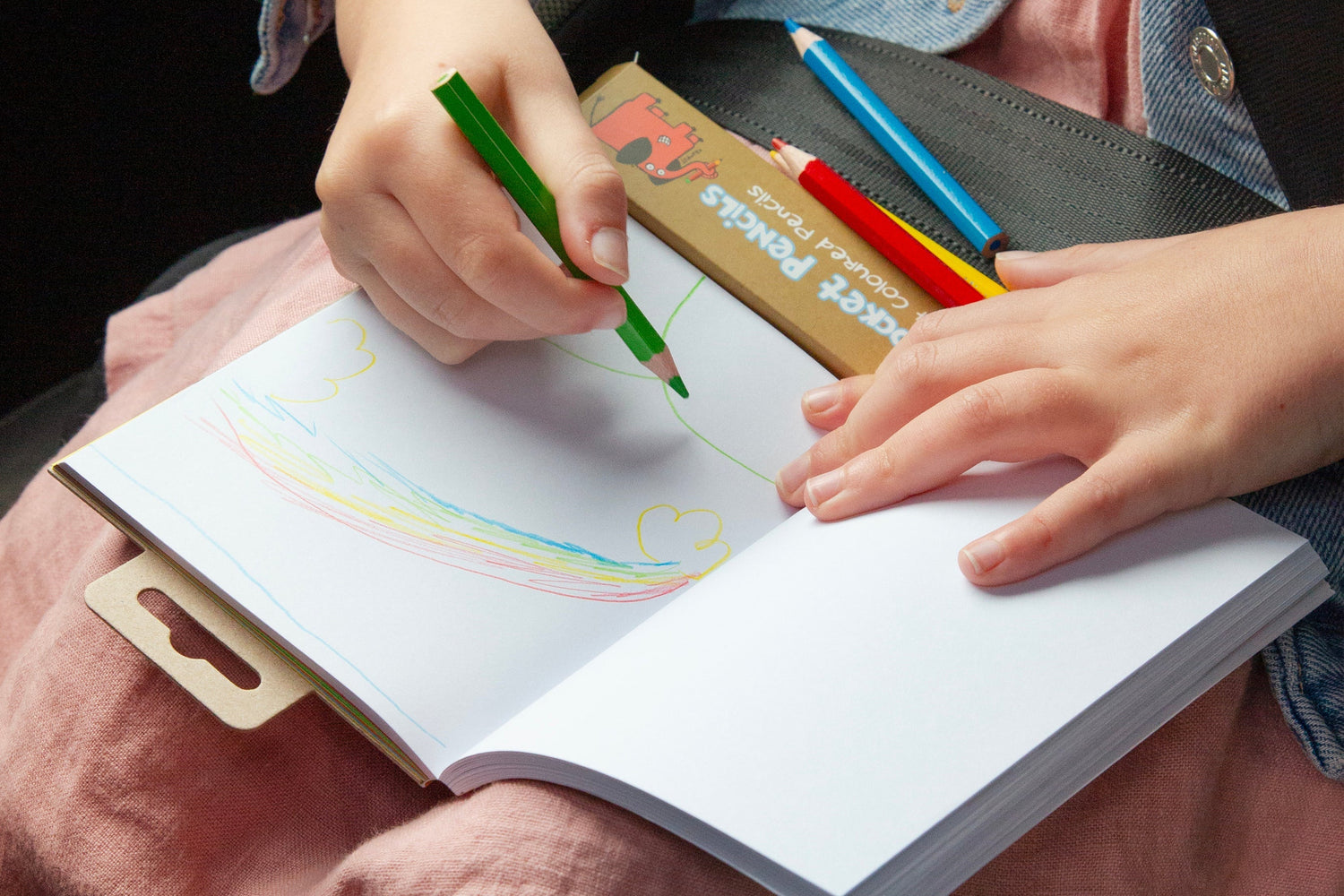
Somewhere around Year 4 or 5, something happens that most parents don't notice until it's done. Your child, who used to draw constantly, stops. The sketchbooks get pushed to the back of the shelf. The pencils stay in the case. If you suggest drawing, you get a shrug or something more definitive: "I can't draw."
This isn't a phase. It's a well-documented developmental crisis, and it happens to the majority of children between nine and eleven. Researcher Ellen Winner found that even gifted children actively choose to stop drawing at this age. It's so consistent across populations and cultures that Lowenfeld called it the "dawning realism" stage, the moment when a child's perception of what art should look like overtakes their ability to produce it.
The good news: it's preventable. But you have to understand what's driving it first.
The Gap That Changes Everything
Here's what happens inside a ten-year-old's head. For the first time, they can see the difference between what they intended to draw and what actually ended up on the paper. Their eyes have developed enough to notice proportion, shadow, texture, and spatial depth. But their hands haven't caught up yet.
This is what researchers call the intention-ability gap. It's a completely normal stage of cognitive development. The child who happily drew a stick figure at six is now aware that a stick figure doesn't look like a person. They want realism, but they don't have the technique for it yet.
The gap itself isn't the problem. The problem is how children interpret it.
Three Forces Converging
The dropout doesn't happen for a single reason. Three forces converge at the same time, and together they create an almost irresistible pull away from art.
The cognitive force: The intention-ability gap described above. They can see what's wrong but can't fix it. Every drawing becomes evidence of a shortcoming.
The psychological force: By age nine or ten, most children have absorbed the idea that drawing is a talent: you either have it or you don't. Carol Dweck's research on fixed versus growth mindset explains exactly what happens next. When a child with a fixed mindset hits difficulty, they interpret it as proof that they lack the talent. The logical response? Stop trying. Struggling becomes humiliating rather than educational.
The social force: Peer comparison. At this age, children are acutely aware of each other's abilities. Social hierarchies about who's "good at art" form quickly and can persist for years. A child who feels they're falling behind their peers doesn't just feel frustrated; they feel exposed. Stopping is self-protection.
These three forces feed each other. The skill gap triggers self-doubt, which is amplified by peer comparison, which is interpreted through a fixed mindset lens, which makes the gap feel permanent rather than temporary.
The Dropout Sequence
The withdrawal follows a predictable pattern. First, the child notices the gap between their drawing and reality. Then self-doubt sets in. Then a choice point arrives: push through or protect themselves by stopping. Most choose protection. Over time, that protective withdrawal becomes an identity: "I'm not an art person."
By twelve, the belief is often locked in. And for many people, it stays locked in for life. If you've ever heard an adult say "I can't draw," there's a good chance the story started in Year 4 or 5.
The critical thing to understand: this has almost nothing to do with actual ability. It's about the psychological interpretation of difficulty. Children with identical skill levels can go in completely different directions depending on the mindset framework they're operating in and the feedback they receive.
What Actually Prevents It
Six things. The research is consistent on these.
1. Teach growth mindset explicitly. This isn't motivational poster stuff. It's explaining, in concrete terms, that drawing is a learnable skill that improves with practice. Show them examples. Find before-and-after sketchbooks from artists who started at their age. The neuroscience is real: the brain physically changes structure through practice (neuroplasticity), and the pathways that support drawing get stronger every time they're used. When a ten-year-old understands that struggle is the process of getting better, not evidence of being bad, the whole equation shifts.
2. Change your praise language. This one is subtle but powerful. Talent-focused praise ("You're so talented," "You're a natural") creates fixed mindset. Process-focused praise ("I can see you spent a lot of time on that shadow," "The way you looked at the angle of the roof before drawing it shows real observation") creates growth mindset. Dweck's research shows that children praised for talent are significantly more likely to avoid challenges and give up when things get hard. Children praised for effort and process are significantly more likely to persist and improve.
3. Reduce comparison, increase individual feedback. Public rankings of artwork, even implicit ones (whose work gets displayed, who gets complimented in front of the class), do real damage at this age. What helps is individual, descriptive feedback: telling each child specifically what you notice in their work and asking what they'd change next time. This keeps the focus on their own progress rather than their position relative to others.
4. Teach the skills that match their intent. This is the most practical intervention and the one most often missed. Children at this age want realism. They're frustrated because they can't achieve it. The solution isn't to tell them their symbolic drawings are fine (they can see they're not fine, and empty reassurance makes them trust you less). The solution is to teach them specific, learnable observation skills.
Betty Edwards identified five core skills of observational drawing: edges (drawing outlines from observation, not memory), negative space (drawing the shapes around objects), proportion (measuring sight-size relationships), values (seeing and representing light-to-dark range), and gestalt (stepping back to evaluate the whole). These aren't abstract art theory. They're practical techniques that any child can learn, and they close the intention-ability gap in visible, measurable ways.
Start with contour drawing: have your child put their hand flat on the table, look at the hand (not the paper), and draw every edge and curve they see, very slowly. The result will be messy and weird. But it'll be observed, not symbolic. That shift, from drawing what they think a hand looks like to drawing what they actually see, is the bridge to realism.
5. Prevent "not talented" identity formation. Once a child decides "I'm not an art person," it becomes self-reinforcing. They stop practising, so they stop improving, which confirms the belief. Catch this early. If your child says "I can't draw," don't argue. Instead, reframe: "You can't draw that yet. Want me to show you a technique for getting the proportions closer?" The word "yet" is small but important. It keeps the door open.
6. Introduce composition as a creative tool. Children at this age are often interested in comics, graphic novels, and sequential storytelling. Composition, the deliberate arrangement of visual elements, gives them a framework for making drawings that communicate effectively, even before their technical skills are fully developed. The rule of thirds, foreground and background, and visual storytelling through panel layout are all accessible to nine-to-twelve-year-olds and make their work feel more "finished" without requiring photographic realism.

Materials That Help
At this stage, materials matter more than they did when your child was five. A blunt pencil that won't hold a point, cheap paper that tears when erased, or crayons that can't produce fine lines will amplify the frustration rather than reduce it.
What helps: a range of pencil grades (HB for sketching, 2B and 4B for shading, 6B for dark values), a quality eraser (this sounds minor, but a good eraser gives permission to make mistakes), fine-liner pens for confident line work once the pencil sketch is done, and a sketchbook with paper heavy enough to handle erasing without disintegrating.
Charcoal is surprisingly useful at this age. It's forgiving, it covers large areas quickly, it blends with a finger, and it produces results that look "real" faster than graphite. For a child who's frustrated by slow progress, charcoal can be the material that shows them what's possible.
The Window Is Open Now
Here's the thing about the dawning realism stage: it's a crisis, but it's also an opportunity. The child who learns to close the intention-ability gap at ten, who discovers that observation skills are learnable and that practice produces visible improvement, develops something far more valuable than drawing ability. They develop resilience, a willingness to push through difficulty, and the understanding that competence comes from effort, not talent.
The window for this intervention is roughly ages nine to twelve. By thirteen or fourteen, Lowenfeld's "period of decision" arrives, and the trajectory becomes much harder to change. The children who came through the realism crisis with their creative confidence intact tend to sustain that confidence. The ones who concluded "I can't draw" often carry that belief for decades.
So if your child is somewhere in Year 4 to 6 and you've noticed the sketchbooks gathering dust, this is the moment. Not to push, not to insist, but to teach. Show them a technique. Sit down and draw with them. Point out what they're doing well, specifically. And above all, help them understand that what they're experiencing isn't failure. It's the beginning of getting good.
Ask Klumpf about why your 10-year-old says "I can't draw", what to do when they want to quit, or which materials make starting again easier. Micador's in-house art expert. Bottom-right of every page.
Next in this series: "The Teenage Art Crisis: Why Adolescent Creativity Matters"
© 2026 Micador Group. All rights reserved. This article is original editorial content produced by Micador. You're welcome to link to it or quote short passages with attribution. Reproducing the article in full, or republishing it on another platform, requires written permission — amazing@micador.com.au.


Leave a comment
All comments are moderated before being published.
This site is protected by hCaptcha and the hCaptcha Privacy Policy and Terms of Service apply.