
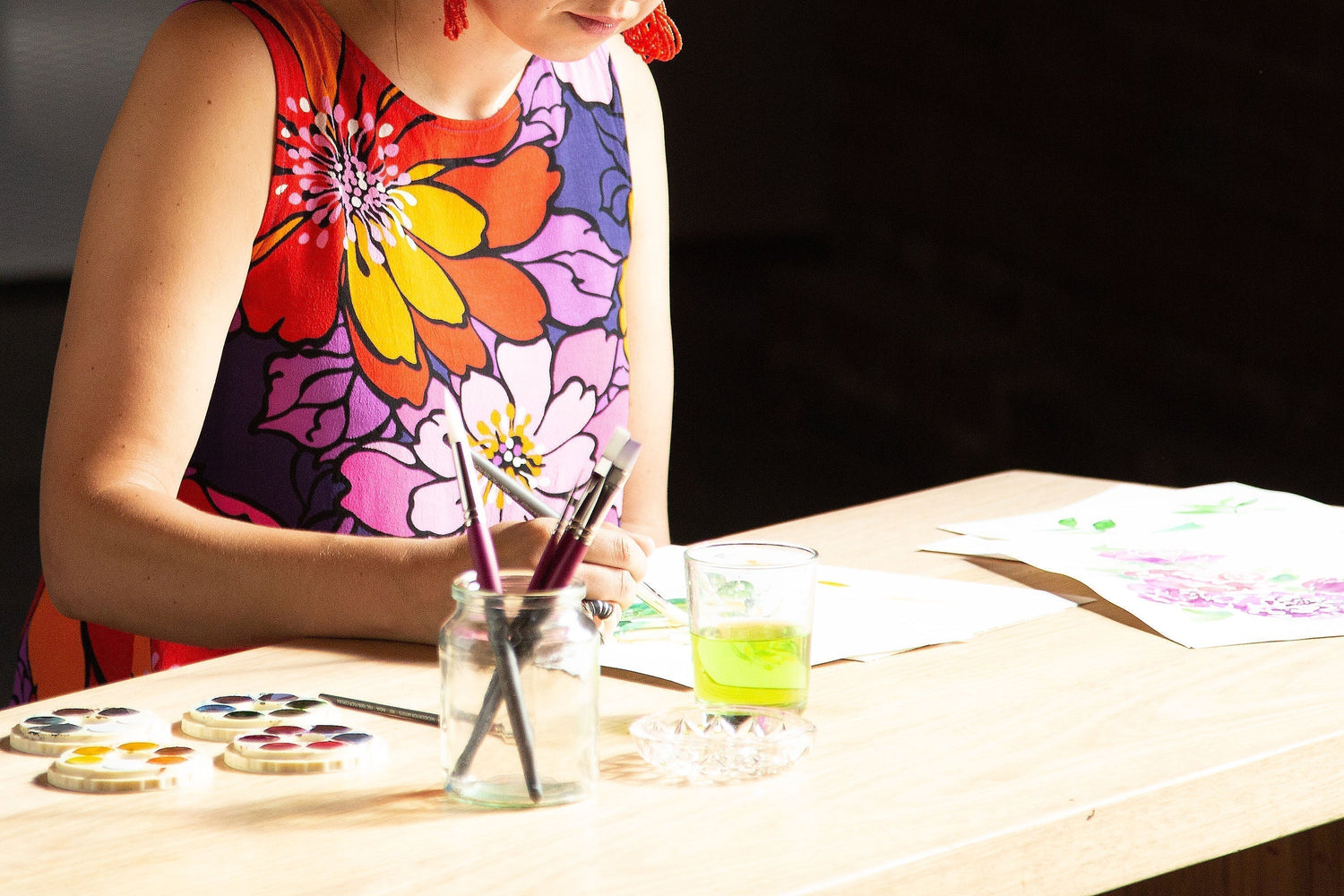
Most adults who stopped making art didn't lose interest. They lost permission.
Somewhere between childhood and now, the experience shifted. Where a child draws freely, capturing a person as a circle with lines for arms, an adult demands accuracy. The gap between what you see and what you can produce becomes visible. And for most people, it feels unbridgeable.
Julia Cameron, whose work on creative recovery has been studied for over three decades, identifies this as the "Censor": a leftover from the survival brain that once warned about danger and now warns about embarrassment, failure, and judgment. The Censor tells you your work isn't good enough, you're too old to start, and real artists have natural talent you'll never develop.
The research on adult learners is consistent: this isn't a personal failing. It's a predictable psychological response tied to self-consciousness and comparison. Children don't compare. Adults do. Children don't judge their output. Adults do ceaselessly.
Here's the thing worth knowing: the Censor is wrong on every count.
Your Brain Can Still Do This
Adult brains retain the capacity to learn new creative skills at any age. This isn't motivational language. It's neurobiology.
Neural connections remain adaptable throughout life and can be reshaped through new experiences. When you engage in creative activities, multiple sensory, emotional, and cognitive systems activate simultaneously. Over time, this repeated activation strengthens neural pathways associated with attention, emotional regulation, and flexible thinking. The more you draw, the more efficient your brain becomes at drawing. Not just your hand. Your brain.
Recent neuroimaging from Drexel University's Creativity Research Center shows something particularly useful: during flow states (that feeling of complete immersion where self-consciousness disappears and time seems to vanish), the brain's default mode network, the part that usually produces self-criticism, temporarily quiets down. For those hours spent in the flow state, your inner critic is literally offline.
Mihaly Csikszentmihalyi's research on flow found it occurs when two conditions align. First, challenge level matches skill level: the task is hard enough to engage you fully, but not so hard you feel helpless. Second, clear goals and immediate feedback: you know what you're aiming for, and you can see whether you're getting closer. This is why a blank canvas can feel paralysing (no clear goal) and a structured exercise feels liberating (achievable micro-goals that let flow emerge).
The Advantage Nobody Mentions
There's an unexpected benefit to returning to art as an adult: mature brains often make better creative decisions than young ones.
You have decades of lived experience, relationships, work, loss, that informs visual choices. An adult painting a landscape brings accumulated knowledge about light, colour, and composition that a younger person simply hasn't yet built. Adult emotions are more nuanced and can sustain longer periods of focused creative work. And your prefrontal cortex has developed capabilities, the ability to persist through difficulty, to revise work, to think strategically, that younger brains are still developing.
Returning to art as an adult isn't catching up. It's playing to strengths you didn't have as a younger person.
Choosing Your Medium
An adult choosing their first art medium is making an invisible choice about whether they'll persist or quit. The barrier to entry isn't ability. It's frustration tolerance during the learning phase. Choose a medium with a gentler frustration curve and you're more likely to stay. Choose one with a steep curve, and you might stop before reaching the satisfying phase.
This isn't judgment. It's learning science. Different media have different learning progressions.
Graphite drawing is the lowest barrier. No equipment burden (everyone has a pencil and paper), immediate mark-making, forgiving (mistakes erase), and the cost is negligible. Most adult beginners produce recognisable, satisfying work within three months. The frustration curve is gentle, and early wins build momentum. If you're uncertain whether you want to commit, start here.
Coloured pencils sit between drawing and painting. Similar setup to graphite, colour without mixing complexity, and layering introduces skill development at your own pace. Cost is moderate. Learning curve is gentle, slightly steeper than graphite.
Acrylic paint is more forgiving than watercolour but more complex than pencils. Water-soluble, fast drying, opaque (lighter colours cover darker ones, so you're not locked into a sequence), and it works on almost any surface. Most beginners confidently produce a painting by week 12. The frustration phase is real but shorter than watercolour, and around week 6 the medium often "clicks."
Watercolour has a reputation for beauty and difficulty. Both are deserved. It's transparent (you can't easily paint over mistakes), unpredictable (humidity, paper wetness, and brush load all affect results), and it requires genuine technical skill. Competence typically takes 6 to 12 months of regular practice, not weeks. The risk zone is weeks 6 to 12, when you can see improvement but frustration remains high. Many adults quit here, just before the breakthrough.
Why choose watercolour despite all that? The luminosity is unmatched. A watercolour painting can be completed in 45 minutes. The kit is compact and portable. And the fluidity creates a meditative quality that many adults find deeply rewarding once they're through the learning curve.
The practical comparison:
Graphite: 4 to 8 weeks to competence. Frustration risk: low. Cost to start: $10.
Coloured pencils: 8 to 12 weeks. Frustration risk: low to moderate. Cost: $30.
Acrylic: 8 to 12 weeks. Frustration risk: moderate. Cost: $40.
Watercolour: 24 to 52 weeks. Frustration risk: high (weeks 6 to 12). Cost: $50.
Don't choose watercolour because someone told you it's the "proper" medium. Choose it because you're genuinely drawn to its aesthetic and you have patience for the journey. Choosing for the wrong reasons leads to abandonment around week 10.

The Frustration Phase
Regardless of medium, there will be a frustration phase. This isn't optional. It's neurological.
Weeks 1 to 3: the honeymoon. Everything is new. Progress feels rapid. Enjoyment is high.
Weeks 4 to 8: frustration. You can now see the gap between what you want to make and what you're actually making. Your eye is improving faster than your hand. Many learners quit here.
Weeks 9 to 16: integration. Skills begin to integrate into automatic processes. The work starts to look like you intended. Surprises happen.
Month 4 onward: flow. The medium becomes an extension of your thinking. Technical execution becomes less conscious. Creative exploration becomes possible.
Knowing this timeline in advance is the single most effective thing you can do. If you expect weeks 6 to 10 to be hard, you won't interpret difficulty as failure. You'll interpret it as the schedule.
Other things that help: reduce comparison (unfollow expert artists, follow fellow beginners), lower the stakes (deliberately create "bad" art to prove it doesn't matter), increase frequency (three sessions a week beats one long session), and change the goal (stop aiming for "good paintings," aim for "completed pieces").
The Mixed Media Option
Many adult beginners assume they must choose one medium and master it. This is false.
Mixing media, drawing then adding watercolour then collage, removes the pressure to be "good" at any single thing and invites play. Many adults rediscover their creativity through mixed-media work precisely because there's no single "right way" to do it. Watercolour pencils, water-soluble markers, pen and wash: these hybrid approaches let you experiment without commitment.
If you're anxious about choosing the "perfect" medium, consider starting with mixed media. The anxiety about choosing correctly often prevents choosing at all.
What to Actually Buy
Drawing kit ($20): HB pencil (standard), 2B and 4B pencils (softer, for shading), eraser, sharpener, A4 sketchbook.
Acrylic kit ($40): Pre-made starter set with basic colours, synthetic brushes in 3 to 4 sizes, canvas paper pad, water container, paper towels. Skip expensive brushes and mediums for now.
Watercolour kit ($50): Travel set with 12 to 24 colours, round and flat brushes (synthetic is fine), watercolour paper pad, two water containers. Critical: cheap watercolour paper sabotages learning. The paper needs weight and absorbency. Thin paper buckles and muddies colours. Spend $15 to $20 on paper. It makes a genuine difference.
Starting
Find a class, workshop, or community where adult beginners gather. The normalisation of struggle is essential. Online communities work. In-person works better because you see other adults making imperfect work in real time.
Expect the phases. Know the plateau is coming. Many adults stop just before the breakthrough happens. Reading about this phase in advance, knowing it's normal, significantly increases persistence.
Before each creative session, spend 10 minutes sketching or writing unfiltered thoughts. Cameron calls these "Morning Pages." The mechanism works because once you externalise the useless thoughts, the Censor loses power through exposure rather than suppression.
Redefine success. For an adult beginner, success is not "make a gallery-worthy painting." Success is: showed up, engaged with the material, experienced flow for 20 minutes, and surprised yourself with a colour choice you wouldn't have made otherwise. These small wins are how neural pathways strengthen.
The gap between what you see and what you can produce today will close. Not because you're special or talented, but because your brain is neurologically designed to improve through repeated, engaged practice. You've done this before in other domains of your life. You can do it here.
Ask Klumpf about coming back to art, choosing your first kit, or which medium has the gentlest learning curve. Micador's in-house art expert. Bottom-right of every page.
Shop the Micador watercolour range.
Next in this series: "Colour, Composition and Practice: How to Actually Improve Your Art"
© 2026 Micador Group. All rights reserved. This article is original editorial content produced by Micador. You're welcome to link to it or quote short passages with attribution. Reproducing the article in full, or republishing it on another platform, requires written permission — amazing@micador.com.au.

1 comment
Sharon
A very interesting read – well written, with some great insight into how to choose your medium – mone is watercolour; sometimes has a mind of it’s own, but I love it for all of the reasons mentioned here, and I enjoy the challenge. Thanks for the article!
Leave a comment
All comments are moderated before being published.
This site is protected by hCaptcha and the hCaptcha Privacy Policy and Terms of Service apply.