
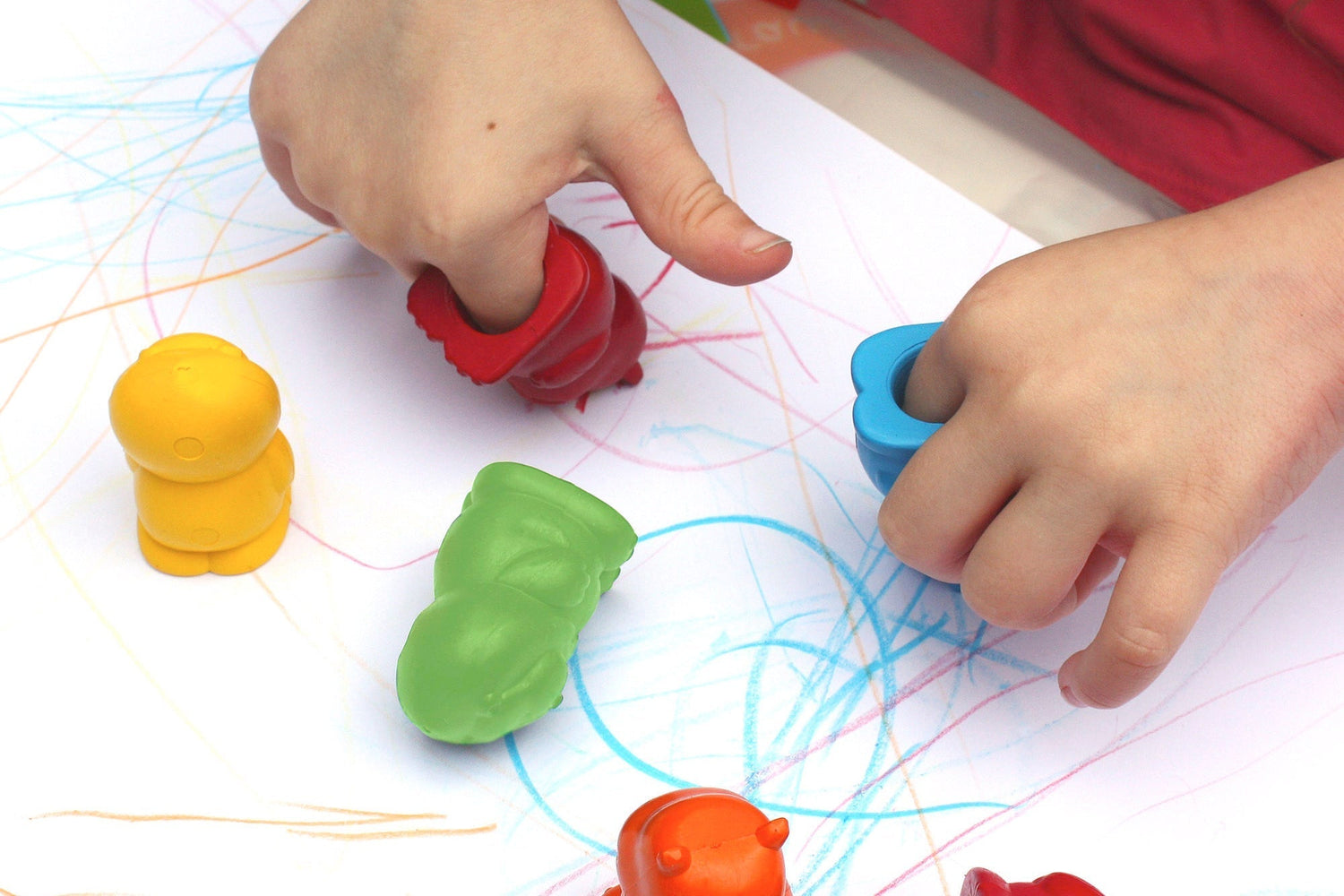
Your baby has just dragged a chunky crayon across a piece of paper for the first time. The result looks like nothing. A few wobbly lines, some dots where the crayon was pressed too hard, and a fair bit of colour on the table.
Here's what actually just happened: your baby's brain sent a signal to their hand, the hand moved in response, and your baby watched the result appear. That single scribble is cause and effect in its purest form. And it's one of the most important things your baby will learn this year.
What's Really Going On Inside That Little Head
During the first three years of life, your baby's brain forms new neural connections at a rate of more than one million per second. That's not an exaggeration or a metaphor. The brain is literally rewiring itself constantly, building the architecture that will support everything from reading to riding a bike.
But here's the catch: the brain doesn't keep all those connections. In a process called synaptic pruning, pathways that rarely get used are eliminated. The ones that fire repeatedly become stronger and permanent. By adulthood, roughly half of those early connections are gone.
What does this mean for scribbling? Every time your baby makes a mark on paper and watches it appear, three systems fire simultaneously. Vision processes the mark. Touch feels the crayon's resistance. The motor system controls the arm movement. And the prefrontal cortex registers: "I did that. My action caused that result."
Repeat that a dozen times, and you've got a visible neural trail. A hundred times, and it's a paved road. The pathways that scribbling builds, hand-eye coordination, fine motor control, cause-and-effect understanding, become part of your baby's permanent brain architecture.
A baby who scribbles regularly at 15 months will have better pencil control at four, better fine motor dexterity at seven, and better writing skills at ten. All from marks that looked like random chaos.
The Grip Journey: From Fist to Fingers
Before your baby can scribble, their hand has to be ready to hold a tool. This develops in a predictable sequence, and understanding it helps you pick the right materials at the right time.
Birth to 4 months: Your newborn has a reflexive grasp. Place a finger in their palm and it closes automatically. This is hardwired survival, not voluntary control. Art materials? Not yet.
4 to 8 months: Voluntary grasping begins. Your baby can hold a toy placed in their hand using the whole palm, but the thumb isn't really involved. They can't pick things up independently or release them on purpose. Still too early for tools.
8 to 12 months: This is where it gets interesting. The thumb becomes independent from the fingers for the first time. Your baby develops the pincer grasp, holding small objects between thumb and index finger. By 12 months, this grip is precise enough to pick up a single cheerio. The hand is nearly ready for a crayon.
12 to 18 months: The sweet spot. Your baby can hold a chunky crayon in a full-hand "power grasp," similar to how you'd grip a tennis racket. The marks are big, whole-arm movements. This is exactly where development should be.
15 to 24 months: Gradually, the grip refines. The thumb separates from the fingers more deliberately. Some toddlers start holding crayons with a three-point grasp. Many don't manage this until closer to age three, and that's completely normal.

The Three Stages of Scribbling
Developmental researcher Viktor Lowenfeld identified three distinct phases within scribbling, and they're worth knowing because they show you what your baby is actually learning:
Disordered scribbling (12 to 18 months): Large, random marks everywhere. Your baby is focused entirely on the sensation of moving their arm and watching something happen. There's no intention to draw anything specific. The scribbles are chaotic, overlapping, and cover the whole page. This is kinesthetic exploration, pure and simple.
Controlled scribbling (18 to 24 months): The marks become more deliberate. Your baby starts to notice the direction of the mark and may deliberately draw in specific areas of the paper. Straight lines, zigzags, and circular motions appear. Your baby now understands: "I can control where the mark goes."
Planned scribbling (emerging around 24 months): Your baby starts naming their scribbles. "This is a dog." "That's Mummy." There's no visual resemblance whatsoever, but your baby has made the leap from motor exploration to representational thinking. They've connected a mark with an idea. This is the bridge to everything that comes next.
Why Sensory Play Matters More Than You Think
Scribbling isn't just about the hand. It's a full sensory workout.
When your baby finger-paints, vision watches the colour spread, touch feels the cool wet paint, proprioception senses how hard the hand is pressing, and the vestibular system registers head movement as they look at their work. All of these systems fire at the same time, and the connections between them strengthen with every session.
This cross-system integration is how the brain builds sophisticated abilities. A baby who only experiences one type of sensory input never develops these integrated skills as effectively. Art materials are powerful precisely because they engage multiple systems simultaneously.
Two factors make sensory play effective. First, repetition. A single finger-painting session teaches something. A dozen sessions build a durable pathway. Daily sensory play, even for 10 minutes, builds stronger neural architecture than a one-hour session once a week.
Second, variety. Different sensations activate different brain circuits. A baby who touches only cotton never develops pathways for rough, sticky, or bumpy textures. The more textures, tools, and materials your baby explores, the richer and more complex their sensory map becomes.
The Material Matching Guide
Here's where a lot of well-meaning parents go wrong. They give their 10-month-old a thin coloured pencil, watch the baby struggle to hold it, and conclude: "They're not interested in art yet."
What's actually happening is a mismatch. The tool doesn't fit the grip stage. Give that same baby a chunky crayon at 12 months and the response is completely different, because the tool matches what their hand can do.
12 to 18 months: Chunky crayons (8 to 12 mm diameter) and fat markers are ideal. These match the power grasp perfectly. Washable finger paints are great for supervised sensory play. Avoid thin crayons, pencils, or anything requiring fine finger control.
18 to 24 months: Continue with chunky crayons (many toddlers prefer them through age three). You can introduce slightly finer crayons if your child shows readiness, along with washable markers with ventilated barrels, play dough, and large pre-cut collage shapes. Still avoid pencils and fine markers.
The tension trap: When a child grips a tool that's too advanced for their stage, they compensate by gripping harder. If this becomes habitual, it can create muscle tension that interferes with fine motor skills later. Occupational therapists strongly recommend matching tool size to grip stage and letting your child lead. If they're not interested, don't force it.
Safe Materials: What to Actually Look For
Here's something most parents don't know: the term "non-toxic" is not regulated. Any manufacturer can write it on a product without third-party testing. A product labelled "non-toxic" has only passed a short-term toxicity test. Long-term safety? Not guaranteed.
What you actually want is products from a range built specifically for this age. early stART covers ages 1 to 4 — the toddler-to-young-preschooler stage. Micador jR. picks up at 3 and runs to 8, so 3- and 4-year-olds sit in the overlap and either works. Both ranges are designed from the formulation up for the way young children actually use art supplies, mouthing included.
For under-threes, choking is the other priority risk. The rule of thumb: anything that fits through a toilet roll tube (roughly 31 mm in diameter) is a choking hazard. early stART is built so this check passes by default — chunky everything, no detachable caps, no small parts.
The practical checklist:
Stick to ranges designed for this age — early stART covers ages 1 to 4 and is built around the reality of mouthing. Make sure nothing detaches (no caps, lids, or barrel components that could separate). Use chunky tools designed for small hands. Stay within arm's reach at all times. Babies under 24 months still mouth everything, so constant supervision is non-negotiable.
Labels to avoid: Anything saying "Keep Out of Reach of Children," "Not for Use by Children," or carrying any caution-label warning. These products contain materials that may cause health problems and should never be given to under-eights.
What Scribbling Isn't
It's worth being clear about this, because parents often misinterpret what's happening:
Scribbling is not a mess. It's purposeful neural activity. The "mess" is evidence of learning.
Scribbling is not preparation for handwriting. It's earlier and more fundamental than letter formation.
Scribbling is not artistic self-expression. Not yet. Your baby isn't trying to create a picture or express emotions through art. The focus is purely motor and sensory.
And scribbling is not something to rush through. Your baby doesn't need to "graduate" from scribbling to something more sophisticated. Scribbling is exactly where development should be, and it'll run its course naturally.
When to Be Concerned
Most babies start making marks spontaneously once they have the grip strength, around 12 months. But it's worth keeping an eye on a few things.
If your child reaches 18 months and shows no interest in mark-making despite regular access to materials, that's worth noting. If they can't hold a crayon at all by 18 months, or if they grip with extreme tension that makes their hand shake, it may indicate a motor planning issue. If you notice significant grip asymmetry (one hand much stronger or more skilled than the other), mention it to your early childhood health service.
Most variations are completely normal, and early support is available if you need it.
The Bottom Line
That scribble on the paper? It represents an extraordinary amount of brain development. Neural pathways forming, grip strength building, cause-and-effect understanding emerging, and multiple sensory systems integrating for the first time.
The best thing you can do is keep it simple. Chunky crayons at 12 months from a range built for this age (early stART), regular opportunities to make marks, and absolutely zero pressure to produce anything that looks like a picture.
The messy scribble phase is building the foundation for everything that comes next. And honestly? It's worth celebrating, even if the artwork doesn't make it to the fridge just yet.
Ask Klumpf about your baby's first marks, the palmar grasp, or which crayons survive a 1-year-old. Micador's in-house art expert. Bottom-right of every page.
Next in this series: "When Scribbles Become Stories: Art Development from 3 to 8"
© 2026 Micador Group. All rights reserved. This article is original editorial content produced by Micador. You're welcome to link to it or quote short passages with attribution. Reproducing the article in full, or republishing it on another platform, requires written permission — amazing@micador.com.au.

Leave a comment
All comments are moderated before being published.
This site is protected by hCaptcha and the hCaptcha Privacy Policy and Terms of Service apply.