
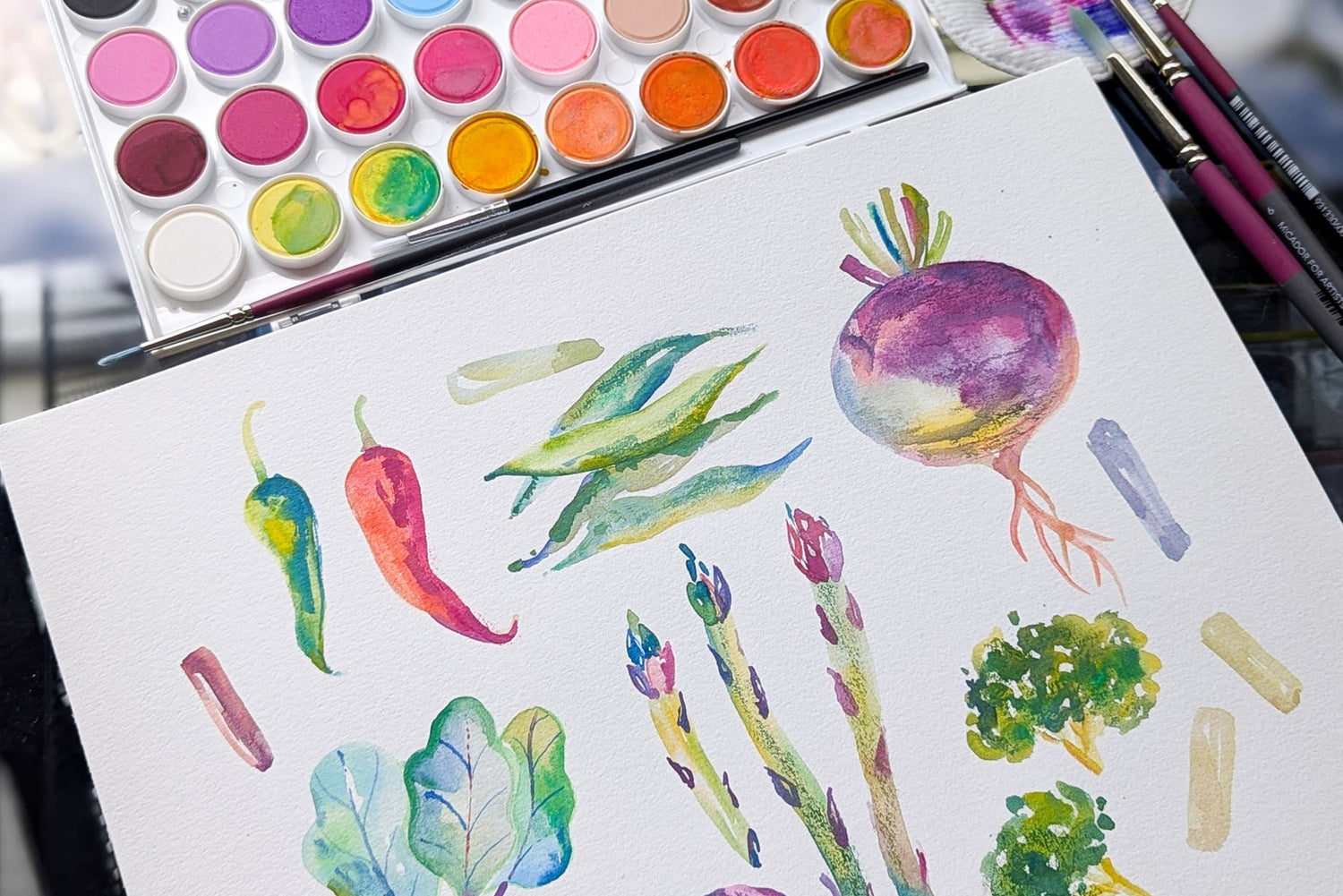
Artists talk about technique constantly. They talk about materials far less, which is strange, because the material you work with determines what technique is even possible. You can't achieve luminous watercolour glazes on cheap paper. You can't control water flow with a brush that won't hold a point. Understanding what's inside your materials is understanding what your art can become.
How Paint Actually Works
All paint has the same basic structure: pigment (the colour) suspended in a binder (the glue that holds pigment to the surface). What changes between paint types is the binder.
Watercolour uses gum arabic as its binder, traditionally sourced from the Acacia senegal tree. When you wet a watercolour cake or squeeze a tube, the gum arabic dissolves in water, releasing the pigment. The water carries pigment across the paper surface, and as the water evaporates, the gum arabic re-bonds the pigment to the paper fibres. This is why watercolour can be rewetted and lifted: the gum arabic bond is water-soluble.
The grade of gum arabic matters. HPS-grade (hand-picked select) Kordofan gum arabic, sourced from Sudan, is the standard used in professional tubes. It provides superior pigment suspension and rewettability compared to lower-grade alternatives. The same binder grade appears in tubes costing two to three times the price of quality mid-range options.
Acrylic uses a polymer emulsion as its binder. When acrylic paint dries, the water evaporates and the polymer particles fuse together into a continuous, flexible plastic film. This film is permanent and water-resistant once dry. This is why acrylic can't be rewetted like watercolour, and why it dries darker than it appears when wet (the polymer film is more transparent than the wet emulsion).
Oil uses a drying oil (typically linseed) as its binder. The oil doesn't evaporate; it oxidises, forming a hard, durable film through chemical reaction with oxygen. This is why oil paint takes days or weeks to dry and why it remains workable far longer than acrylic.
Pigments: What Creates Colour
Pigments are finely ground particles that absorb certain wavelengths of light and reflect others. A red pigment absorbs blue and green light and reflects red. The specific chemical composition of the pigment determines its colour, transparency, lightfastness, and mixing behaviour.
Single-pigment paints contain one pigment. They produce the cleanest mixes because there are fewer pigment particles interacting. When you mix two single-pigment colours, you're combining two pigments. When you mix two multi-pigment colours, you might be combining four, five, or six pigments, and the result is often muddy.
This is why reading pigment codes on tubes matters. The code tells you exactly what's inside. PB29 is ultramarine blue (a single pigment). A tube labelled "Sky Blue" might contain PB15, PW6, and PB29, three pigments already mixed, which limits your control over the result.
Transparency and opacity vary by pigment. Some pigments are naturally transparent (light passes through them and bounces off the paper beneath, creating luminosity). Others are opaque (light bounces off the pigment surface, creating flat coverage). In watercolour, transparency is prized because it creates the medium's characteristic glow. Transparent pigments layered over each other create optical mixing: the colours blend in the viewer's eye, not on the paper.
Lightfastness describes how resistant a pigment is to fading under light exposure. Pigments are rated on standard scales (ASTM rates from I (excellent) to V (poor)). Fugitive pigments fade significantly within years. For any work you want to last, check lightfastness ratings. Professional-grade paints typically use only highly lightfast pigments.

Paper: The Most Underestimated Material
In watercolour, paper matters more than paint. This is not exaggeration. The same pigment on cheap paper and quality watercolour paper produces fundamentally different results.
Weight is measured in grams per square metre (gsm). Lightweight paper (under 200gsm) buckles when wet, creating pools where pigment collects unevenly. Medium weight (300gsm) handles most watercolour techniques without buckling. Heavy weight (600gsm+) behaves almost like board: completely stable, even when soaked.
For serious watercolour work, 300gsm is the working standard. Below that, you're fighting the paper instead of working with it.
Fibre composition determines absorbency and texture. Cotton fibre paper (sometimes labelled "rag") absorbs water slowly and evenly, allowing longer working time. The pigment sits in and on the fibres, creating luminosity as light passes through the pigment and reflects off the white fibres beneath. Cellulose paper (wood pulp) absorbs water rapidly and unevenly. Pigment sits on the surface rather than bonding with the fibre, producing flatter colour and less working time.
Cotton content matters. 100% cotton paper is the professional standard and performs noticeably better than blended cotton/cellulose papers. The difference is visible in how wet washes behave: cotton allows smooth gradients, while cellulose creates hard edges and uneven absorption.
Surface texture comes in three standard grades. Hot-pressed (HP) is smooth, suited to detailed work and fine lines. Cold-pressed (CP, also called "Not") has moderate texture, the most versatile surface for mixed techniques. Rough has pronounced texture that breaks up brush strokes and creates granulation effects.
Sizing is the treatment applied to paper that controls absorbency. Internal sizing (mixed into the pulp) controls how deeply water penetrates. External sizing (applied to the surface) controls how water flows across the surface. The balance of internal and external sizing determines whether your washes flow smoothly, puddle, or get absorbed too quickly.
Brush Technology
A brush is a water delivery and shaping tool. Understanding its components explains why some brushes perform and others frustrate.
Natural hair brushes (kolinsky sable, squirrel, goat) have natural scaling on the hair fibre. These microscopic ridges hold water through capillary action, creating excellent water capacity and controlled release. Kolinsky sable is the traditional gold standard: it holds a fine point, carries substantial water, and springs back to shape after each stroke. The drawback: it's expensive, animal-derived, and supply-limited.
Synthetic brushes use manufactured filaments designed to replicate natural hair properties. Modern synthetics have improved dramatically. Advanced filaments include microscopic surface texturing that mimics natural scaling, increasing water capacity. Some synthetic filaments are specifically engineered with tapered tips for point retention.
The best modern synthetics approach kolinsky performance at a fraction of the cost, with the advantage of being vegan and cruelty-free. Japanese filament technology has pushed synthetic brush performance to the point where many professional watercolourists now work primarily with synthetics.
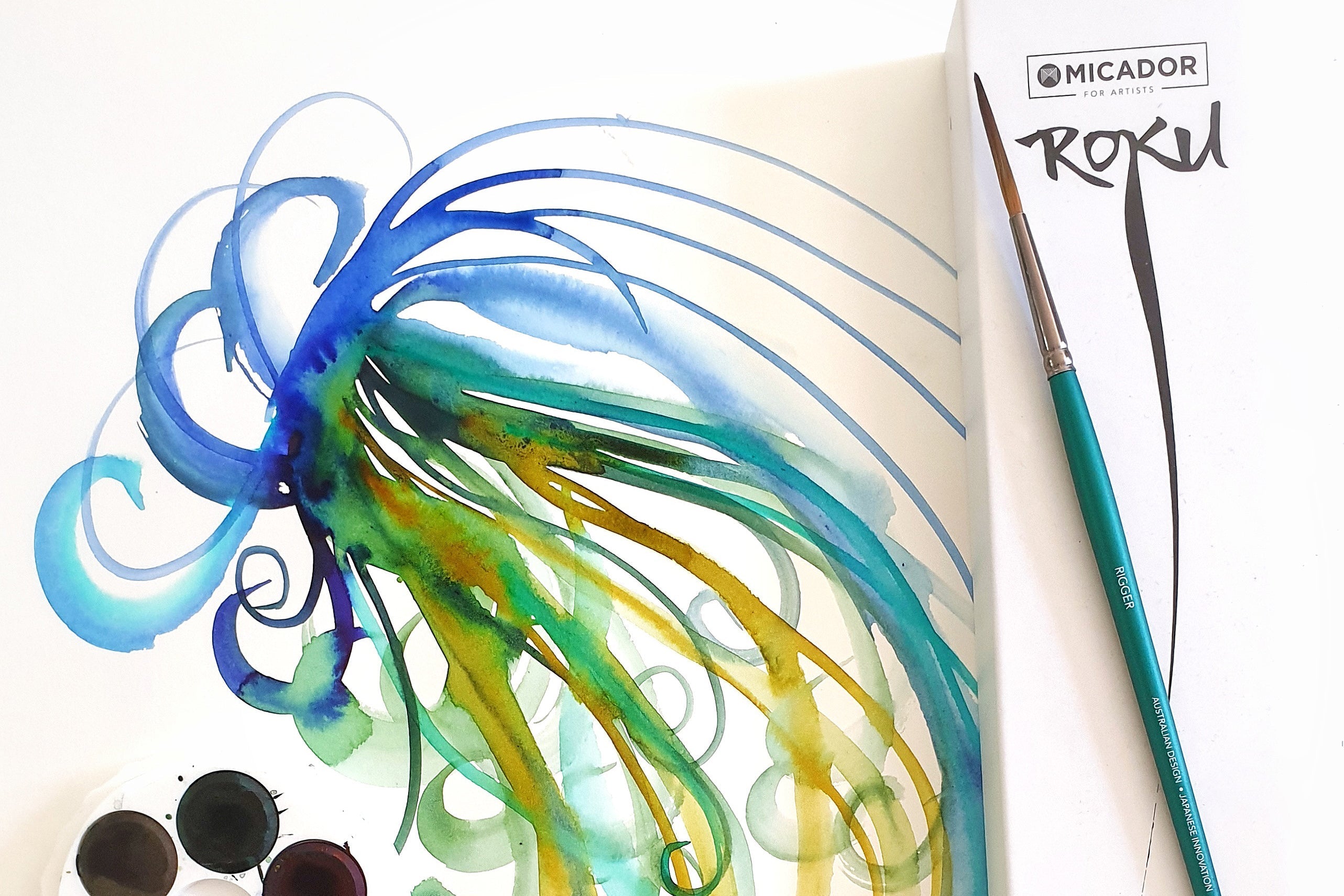
Brush shape determines what marks you can make. Round brushes are the most versatile: they can produce fine lines (using the tip), broad strokes (using the belly), and everything between. Flat brushes create wide, even strokes and clean edges. Mop brushes hold large amounts of water for washes. Rigger brushes have long, thin bristles for fine continuous lines.
What makes a quality brush: It holds its shape after loading with water (the point returns when you lift it from the paper). It carries enough water for a continuous stroke without needing constant reloading. It releases water at a controlled, predictable rate. And it maintains these properties over thousands of strokes.
Water Control: The Hidden Skill
In watercolour, the relationship between water on the brush, water on the paper, and water in the atmosphere determines everything. This is the hidden skill that separates developing watercolourists from experienced ones.
Wet-on-wet means applying wet paint to a wet surface. The pigment disperses and blends, creating soft edges and atmospheric effects. The wetter the surface, the more the pigment spreads. Control comes from managing how wet the paper is (not just how wet the brush is) and from timing: applying pigment at the right moment as the surface transitions from wet to damp.
Wet-on-dry means applying wet paint to a dry surface. The edges are crisp and defined. This is the technique for detail, precision, and clear boundaries.
The transition between wet-on-wet and wet-on-dry is where most of the subtlety lives. As a wash dries, there's a window (watercolourists sometimes call it the "sheen stage") where the surface is damp but no longer pooling. Applying paint during this window produces controlled soft edges: softer than wet-on-dry, more defined than full wet-on-wet.
Learning to read the surface, to see the sheen and know what will happen when you touch it with a loaded brush, is the central technical skill of watercolour painting. No amount of theory replaces the experience of watching water and pigment interact on good paper.
What Justifies Paying More
The honest answer: paper and brushes. These two materials have the most direct impact on your working experience and results.
Quality paper (300gsm, 100% cotton, properly sized) transforms watercolour from a frustrating fight with buckling and uneven absorption into a responsive, predictable medium. It's the single upgrade that makes the biggest difference.
Quality brushes (good point retention, controlled water release, durable filament) let you execute the marks you intend rather than fighting the tool. A brush that won't hold a point forces you to compensate with technique, adding frustration to every stroke.
Quality paint matters, but less than paper and brushes for developing artists. Student-grade paint from a reputable manufacturer uses decent pigments at lower concentrations. The mixes will be slightly less vibrant and the transparency slightly reduced, but the difference is less dramatic than the paper and brush differences. As your skills develop and you begin to rely on specific pigment properties (granulation, staining, transparency), upgrading to professional-grade paint becomes worthwhile.
The order of upgrade: paper first, brushes second, paint third. This matches the research consensus and the practical experience of artists at every level.
Ask Klumpf about pigments, binders, paper construction, or what's actually in your art supplies. Micador's in-house art expert. Bottom-right of every page.
Next series: Technique Guides, starting with "Watercolour for Beginners: Washes, Techniques and Everything You Need"
© 2026 Micador Group. All rights reserved. This article is original editorial content produced by Micador. You're welcome to link to it or quote short passages with attribution. Reproducing the article in full, or republishing it on another platform, requires written permission — amazing@micador.com.au.


Leave a comment
All comments are moderated before being published.
This site is protected by hCaptcha and the hCaptcha Privacy Policy and Terms of Service apply.