
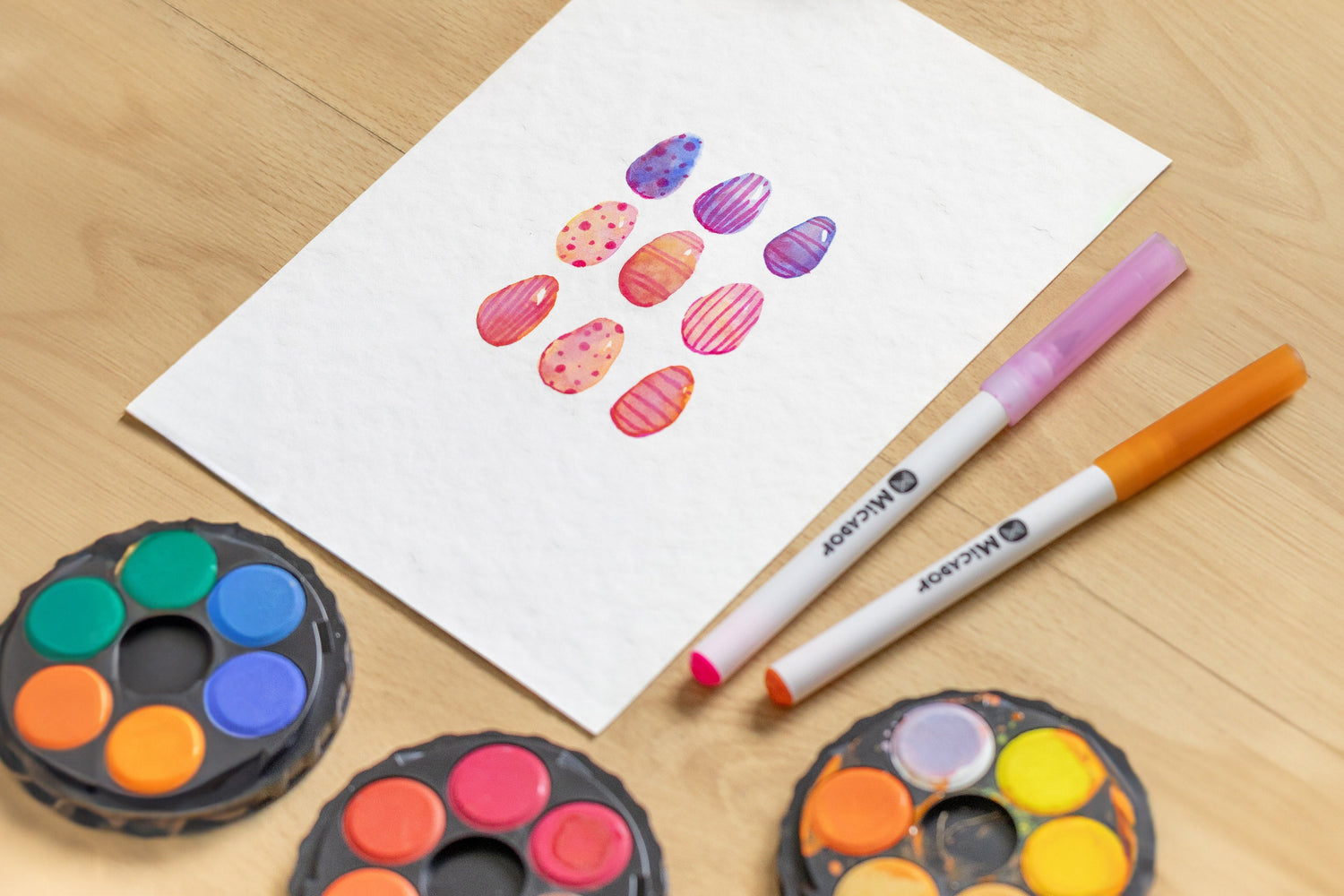
Watercolour looks deceptively simple. You add water to pigment. Pigment flows across paper. Paint dries lighter than it appears wet. But between that simplicity sits a craft that demands precision with materials most people treat as negotiable.
The difference between a controlled watercolour and a muddy accident usually isn't talent. It's understanding the mechanics that separate intention from accident. This guide covers the technical foundations that work.
The Five Essential Washes
A wash is controlled pigment deposited in a defined area. Every watercolour painting is built from wash variations. Learning these five types gives you the vocabulary to plan passages before you paint them.
Flat Wash
A flat wash maintains consistent colour and tone across an area. Not as simple as it sounds.
Preparation matters more than execution. Tilt your board at roughly 15 degrees. Mix pigment generously in a well, adding enough water so you can see the colour shift as you add more water. You're aiming for cream consistency, not milk, not syrup. Pigment particles suspended evenly.
Load your brush fully. Apply a horizontal stroke across the top of your area. The excess pigment pools at the bottom of the stroke. Don't scrub. Apply a second stroke just below, touching the pool. The pigment flows downward by gravity and capillary action. Don't overwork. Let the paint move itself. Add strokes until you reach the bottom. Wick away any pool with a nearly dry brush.
The key detail most people miss: the paper's dampness state. A flat wash requires slightly damp (not wet) paper. Too dry and pigment sits on the surface creating hard edges. Too wet and pigment spreads uncontrollably. You're looking for the paper to have a slight sheen, not visible water pooling.
Practise this until you get one consistently. This single skill eliminates most beginner frustration.
Graded Wash
A graded wash moves from dark to light (or any colour to a different colour). Technique matters here because you're managing transition zones.
Start the same way as a flat wash but add water to your pigment as you move downward. The first stroke uses full-strength pigment. The second stroke uses the same pigment with added water. By the third or fourth stroke, you're mostly water with enough pigment for visibility. Each stroke slightly overlaps the previous one.
The transition should feel gradual, not stepped. If you see distinct bands, you stopped adding water too early. If pigment spreads uncontrollably, you added water too late.
The paper must be slightly damp but not wet. A wet graded wash becomes chaos. A bone-dry graded wash won't blend.
Variegated Wash
A variegated wash blends two or more different colours across a single area. This is where many people panic because water seems to control the outcome, not the artist.
Water does control the outcome. That's the point. You're working with water flow, not against it.
Mix two pigments in separate wells. Dampen the paper to a slight sheen. Apply the first colour as you would a flat wash. While still wet, drop the second pigment into it. The pigments blend where they meet because the water between them becomes a transition zone. Add a third colour if you like. Don't keep adding pigment; two or three is the limit.
The critical detail: timing. If you wait until the first colour dries, the second colour sits on top creating a hard line. If you apply the second colour too early while water pools are still moving, pigment spreads wildly. You're looking for that moment when the first pigment has absorbed into the paper but the surface still has a slight sheen.
Variegated washes teach you more about water control than any other technique. Practise until you can predict where colours will blend.
Wet-on-Wet
True wet-on-wet painting means laying pigment onto a completely saturated surface. This isn't an extension of variegated washes. The mechanics are different.
Pre-wet your entire paper thoroughly. Use clean water and a large, soft brush. You're aiming for the paper to be visibly wet all over. Let it sit for 30 seconds so water absorbs fully into the fibres rather than pooling on the surface.
Now apply pigment. Because the paper is saturated, pigment spreads aggressively. A small mark becomes a large wash within seconds. Gravity and capillary action pull pigment toward lower sections of paper. You can manipulate direction by tilting the board, but you're not directing the pigment with precision. You're allowing it to flow predictably.
This technique doesn't suit detail work. It suits atmospheric effects, skies, water, distant mountains. It teaches you to embrace pigment behaviour rather than force control.
The paper must be genuinely wet. If you're even slightly uncertain whether it's wet enough, it isn't.
Wet-on-Dry
This is layering fresh pigment onto paper that has dried completely. Clean, controlled, the foundation of representational watercolour.
The paper is bone dry. Your pigment is damp but not dripping. Apply with intention. The pigment doesn't spread beyond where your brush deposits it. You create edges, layers, detail.
Each new layer sits on top of the previous layer. Watercolour is transparent. If you paint dark over light, it darkens. If you paint light over dark, you're layering transparency over opacity, which rarely works.
This technique gives you maximum control and is how most finished watercolours are constructed. Wet-on-wet creates atmosphere. Wet-on-dry creates structure.
Water-to-Pigment Ratios and Why They Matter
The ratio of water to pigment determines transparency, flow and drying time. Beginners usually treat this casually. Professional painters obsess over it.
Full-strength pigment is pigment mixed in just enough water for the particles to move. It appears opaque and stains paper darkly. Add water and the pigment particles spread across a larger area, reducing coverage and increasing transparency. At maximum dilution, you have barely visible colour.
The consequences matter. A passage painted at full strength sits on top of layers beneath it. The same passage at half strength allows light to travel through to layers below, creating depth. Shadows painted full strength look flat. Shadows painted at reduced strength create visual space.
The practical rule: mix colours in a well with enough water so you can add more water later without completely losing colour. If your mix is thick, you've created a paint that's hard to control. If it's thin, you've committed to light values before you've even loaded your brush.
Test this on scrap paper before committing to your painting. The colour you see in the well is not the colour you'll see on paper. Paper lightness reflects light through transparent pigment. What looks dark in the well becomes medium on paper.
Reading the Paper's Moisture State
This skill separates competent watercolour from frustrating watercolour.
Paper goes through distinct states as it dries after being dampened:
Visibly wet: Water pools on the surface. Pigment spreads uncontrollably. Useful only for wet-on-wet.
Damp with sheen: The paper glistens but no water pools. This is the sweet spot for flat washes, graded washes and variegated washes. Most early technique work happens here.
Damp without shine: The paper looks damp but doesn't visibly reflect light. Pigment flows but more slowly. Still usable for gentle washes but edges become harder.
Barely damp: Paper feels cool to touch but appears dry. Pigment sits where you place it with minimal spread. Good for detail work or layering.
Bone dry: Paper is completely dry. This is wet-on-dry territory. Pigment has maximum control.
As you paint, paper dries. You can't stop this. You work with it. A passage that required wet-on-wet conditions when the paper was visibly wet becomes a layering opportunity once it dries. Good painters adjust technique as paper dries. Beginners fight the drying, getting frustrated when pigment won't spread the same way it did two minutes earlier.
Accept the paper's state and use it. Don't fight it.

Paper Choice and Why It Matters More Than Paint
Most beginners assume paint quality determines outcome. They're wrong. Paper determines outcome. Paint is secondary.
Watercolour paper must have enough tooth (surface texture) to hold pigment and enough internal strength to survive wet washing. Cheap paper disintegrates when you try to lift pigment or apply wet layers. Good paper remains structurally sound and allows pigment to sit on the surface rather than sinking in.
Paper weight matters. 300gsm (140lb) paper handles wet washes without buckling. Lighter paper (200gsm or less) requires stretching and drying time that slows your practice. If you're learning technique, use 300gsm minimum.
Surface texture comes in three categories:
Hot-pressed: Smooth, minimal texture. Requires control and loads of water because pigment sits on the surface. Difficult for beginners because water control becomes critical.
Cold-pressed: Moderate texture. This is the default choice. Pigment grabs onto surface texture, giving you some forgiveness while maintaining fine detail capability.
Rough: Heavy texture. Pigment sits in valleys, creating effects that hide imprecision. Useful for expressive work but doesn't force technical precision.
Use cold-pressed paper while learning. Once you understand water control, experiment with others.
Paper brand matters because cotton-fibre papers (100 percent cotton) accept washes differently than wood-pulp papers. Arches, Saunders Waterford, and Langton Watercolour paper are expensive but behave predictably. If you're investing time in technique, invest in paper that cooperates rather than fights you.
Common Mistakes and How to Avoid Them
Pushing pigment around after initial placement
Once you've applied pigment, it's down. Overworking creates mud. The definition of mud: multiple pigment layers that have lost transparency and merged into a neutral brown. Overworking is how most beginners create mud.
Apply pigment once. Trust it. If a passage needs adjustment, let it dry and layer on top rather than scrubbing the existing layer.
Insufficient water in the initial mix
Many beginners make pigment too thick. Thick pigment is hard to control and doesn't flow. Mix with confidence. You want cream consistency minimum. Water doesn't weaken watercolour. Watercolour is transparent by design. Water is your tool.
Touching wet pigment with a clean brush to "soften" edges
Touching wet pigment with a clean brush removes pigment and leaves a water mark. If you want a soft edge, apply the pigment slightly softer initially or don't touch it. Clean brushes remove pigment more efficiently than most people expect.
Layering light values over dark values
Watercolour is transparent. Light watercolour paint is transparent pigment diluted with water. Layering transparent light paint over dark paint doesn't lighten it. It muddles it. Paint light values first, then darker passages on top.
Using too many pigments in a single wash
Two pigments in a variegated wash work. Three pigments become chaos. Limit yourself. Master two-pigment blending before attempting more.
Trying to "finish" areas before moving on
Watercolour asks you to work globally, not locally. Work across the entire painting, building layers and relationships. Attempting to finish a passage early usually means overworking it because you go back to "perfect" it. Paint the whole passage at once, then move on.
A Practical Starter Exercise
You need: watercolour paper (cold-pressed, 300gsm), three primary pigments (ultramarine blue, alizarin crimson, cadmium yellow or equivalent), two brushes (one large soft for washes, one medium for detail), water, mixing wells.
Divide your paper into five sections. Paint one flat wash in each section. First section pure ultramarine. Second section ultramarine with increasing amounts of water creating a graded wash. Third section ultramarine and alizarin variegated. Fourth section ultramarine and yellow variegated. Fifth section flat cadmium yellow.
Do this exercise three times. By the third time, you'll predict how pigment behaves. You'll know the right paper moisture state. You'll understand water ratios without thinking about them.
Then repeat with different pigments. Each pigment behaves slightly differently. Understanding the range of behaviours makes you a competent watercolour painter, not a lucky one.
This exercise takes 15 minutes and teaches more than a hundred pages of theory.
Ask Klumpf about the five washes, paper weights, or which three pigments to start with.
Micador's in-house art expert. Bottom-right of every page.
Next in this series: "Acrylic Painting: Techniques, Mediums and Projects for Every Level"
© 2026 Micador Group. All rights reserved. This article is original editorial content produced by Micador. You're welcome to link to it or quote short passages with attribution. Reproducing the article in full, or republishing it on another platform, requires written permission — amazing@micador.com.au.


Leave a comment
All comments are moderated before being published.
This site is protected by hCaptcha and the hCaptcha Privacy Policy and Terms of Service apply.