
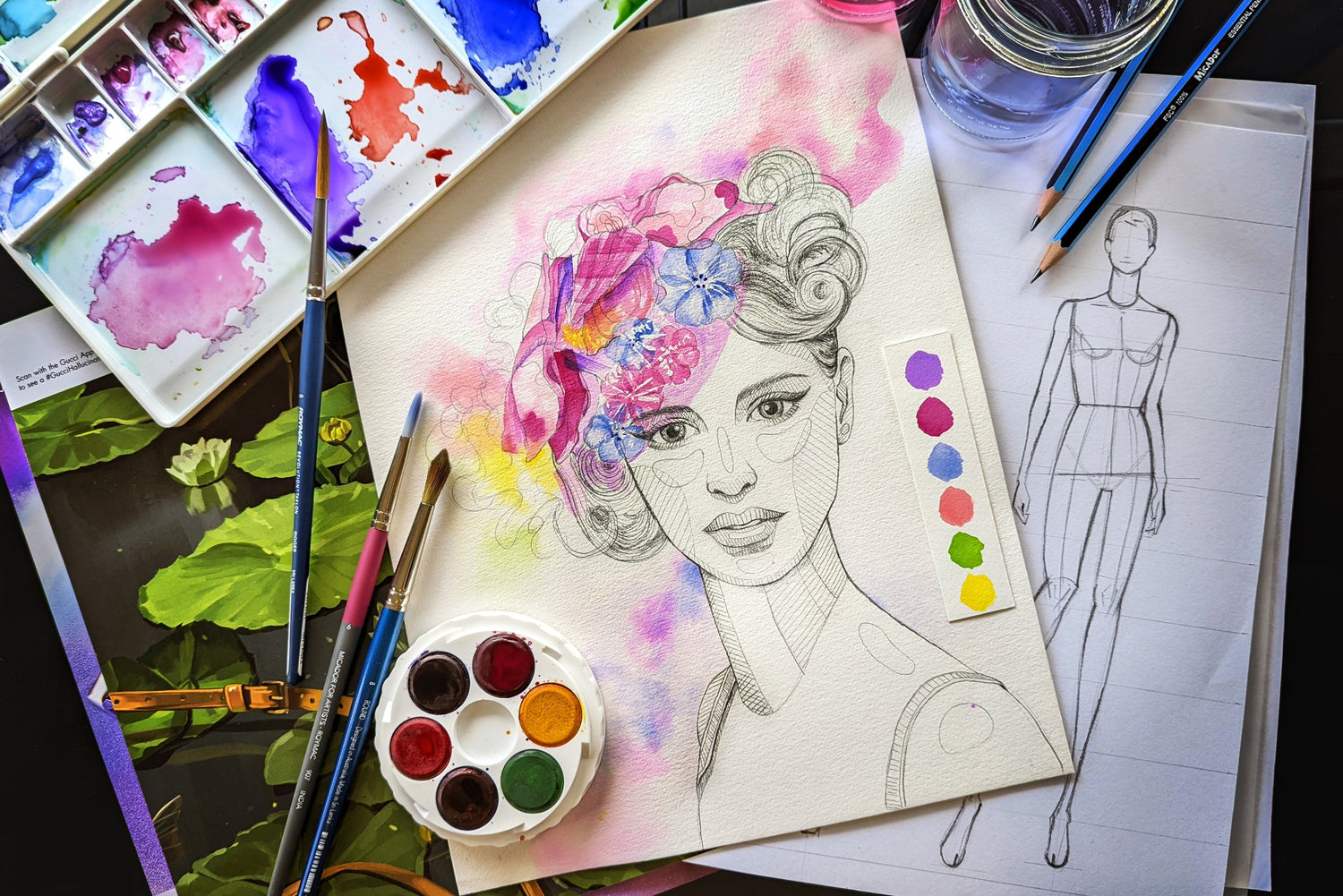
Why Understanding Materials Matters More Than Brand Loyalty
Most artists don't understand what happens to their paint once it touches paper. They know it's wet, that it dries, and that colour appears. The mechanism beyond that is often a mystery. This gap in understanding creates three practical problems.
First, you make poor purchasing decisions. You assume that paying more guarantees better performance, when actually price sometimes reflects brand heritage rather than chemistry. Second, you get frustrated by unexpected behaviour and blame the paint when the issue is actually paper choice or application technique. Third, you can't solve problems when they occur because you don't understand what's going wrong.
The chemistry of art materials is straightforward once you understand the categories involved. Pigment provides colour. Binder makes pigment stick. Additives tune behaviour. Paper determines how everything interacts. Once you understand this framework, you'll spend less money, get better results, and know when to spend more and when to spend less.
What's Actually Inside Paint: Pigments, Binders and Additives
Paint is a suspension of three main components, each doing a completely different job. Artists often conflate these, thinking that pigment quality determines paint quality. The reality is more nuanced and more interesting.
Pigments: Colour and Only Colour
Pigment is the coloured particle that creates the visual effect you see. Pigments do not affect texture, flow, transparency, drying time, or handling properties. They do only one thing: provide colour.
This is a critical distinction. If you assume pigment quality determines paint quality, you'll make purchasing errors. A premium pigment suspended in poor binder will perform worse than a humble pigment in an excellent binder.
Pigments are classified by their source and their properties. Synthetic inorganic pigments (manufactured through chemical processes) are the most common in student and artist grade paints. They're stable, consistent, and affordable. Natural earth pigments (ochres, umbers, siennas) come from mineral sources. They're beautiful but often less intense than synthetic equivalents. Organic synthetic pigments (based on carbon chemistry) produce vivid colours but are sometimes less stable than inorganics.
Each pigment has a standardised code, like PB29 (Ultramarine), PY42 (yellow ochre), or PR101 (red iron oxide). These codes, established by ASTM (American Society for Testing and Materials), appear on paint tube labels and let you identify exactly which pigment you're using regardless of brand marketing language.
Pigment codes matter because pigment is where brands cut corners most aggressively. Marketing language like "ultramarine blue" doesn't tell you whether the paint contains ultramarine pigment or a cheaper alternative. The pigment code does. A tube labeled PB29 contains genuine Prussian blue. A tube labeled PR101 contains genuine red iron oxide. Learn to read codes and you'll spot economic substitutions instantly.
Binders: The Structural System
Binder is what makes pigment permanent. Binder holds pigment particles together and bonds the whole structure to your paper. Different media use different binders, and the binder determines nearly everything about how paint behaves.
In watercolour, the binder is gum arabic, a resin that dissolves in water. This single fact explains watercolour's entire character. Gum arabic suspension holds pigment particles separated and suspended in liquid. When you apply watercolour to paper, water carries the gum arabic and pigment together. As water evaporates, gum arabic remains behind, bonding pigment to the paper fibres.
This mechanism enables watercolour's signature properties: transparency (because gum arabic is clear), rewettability (because gum arabic redissolves in water even when dry), and luminosity (because you're painting on paper, not on a pigmented binder). These aren't accidents. They're direct consequences of the gum arabic binder.
Micador watercolours use HPS-grade Kordofan gum arabic, a hand-picked select grade from Sudan. The HPS designation means "high purity select." Kordofan gum arabic has superior pigment suspension compared to other gum sources. This directly affects rewettability and brush handling. Lower-grade gum arabic from different sources produces acceptable watercolours but with slightly worse pigment suspension and marginally less responsive rewetting.
In acrylic, the binder is acrylic polymer, a synthetic plastic that forms a film when water evaporates. Once dry, acrylic cannot be rewet. This fundamental difference from watercolour changes everything. Acrylic dries permanent and fast. It creates a plastic surface on your paper rather than pigment bonded through resin. This enables acrylic's advantages (fast drying, layering, surface variety) and its limitations (no rewetting, dries darker than wet application, plastic surface rather than pigmented paper).
In tempera (classroom tempera, not Renaissance egg tempera), the binder is typically egg yolk, potato starch, or synthetic starch. These binders create quick-drying paint with a matte finish, ideal for young students. Tempera is non-toxic, washable (when wet), and creates excellent colour with minimal pigment. It's not permanent, but durability isn't the point in educational contexts. The point is engagement, colour expression, and easy cleanup.
Binder choice determines 70% of paint behaviour. Premium binder systems are more expensive than economical ones because quality control is demanding. A poor binder system produces paint that doesn't flow properly, dries unevenly, or separates. A premium system flows beautifully, dries consistently, and suspends pigment reliably.
Additives: Fine-Tuning Behaviour
Additives adjust specific properties without changing the fundamental pigment-binder system.
In watercolour, the critical additive is humectant, typically glycerine. Humectants are hygroscopic compounds that absorb moisture from the air, preventing watercolour from drying out completely. This keeps paint rewettable even after weeks in a palette. Without humectants, watercolour becomes hard and impossible to rewet. With them, you can rewet a dried watercolour pan indefinitely.
Other watercolour additives include wetting agents (improving water penetration), stabilisers (preventing mould and separation), and sometimes thickeners (improving body and reducing flow). The amounts are small but measurable. Student-grade watercolour has fewer additives and simpler systems. Artist-grade watercolour has more sophisticated additive systems tuned to specific pigments and desired properties.
In acrylic, additives include flow improvers (making paint more fluid), matting agents (reducing gloss), thickeners (building body), and retarders (slowing dry time). Acrylic formulae are more complex than watercolour because the water-based plastic film approach requires more tuning to work properly.
In tempera, additives focus on consistency, washability, and colour intensity. These are relatively simple systems compared to watercolour or acrylic.
Understanding additives matters less than understanding pigments and binders, but it explains some mysteries. Why does one watercolour pan stay moist while another dries hard? Likely differences in glycerine content. Why does one acrylic flow beautifully while another feels sticky? Flow improver differences. These aren't quality failures. They're design choices reflecting intended use.
Why Paints Behave So Differently: The Mechanism
Now that you understand components, the behaviour differences become predictable.
Watercolour: Transparent and Rewettable
Watercolour is transparent because you're looking through gum arabic, which is colourless, at pigment suspended in it. Light passes through gum arabic, reflects off pigment particles, and bounces back. The pigment colour comes through but without opacity. This is why watercolour luminosity comes from paper brightness showing through pigment layers. White paper underneath makes colours glow. Dark paper or heavy pigment loads dampen that luminosity.
Rewettability exists because gum arabic redissolves. Tap dried watercolour with a wet brush and the gum arabic releases pigment again. This enables the characteristic watercolour technique of layering and lifting. You can apply, dry, then resume work on the same area because gum arabic lets you back.
This mechanism creates watercolour's magic and its limitations. Magic: infinite rewettability, luminosity, transparency. Limitation: you cannot paint dark opaque colours without covering underlying work. You can only layer from light to dark, never dark to light, because covering power is limited.

Acrylic: Opaque and Permanent
Acrylic is opaque because the acrylic polymer forms a plastic film that blocks light transmission. Pigment is embedded in the plastic matrix. Light hits plastic, scatters, and the pigment colour emerges differently than with transparent watercolour. This is why acrylic colours are more vivid but less luminous than watercolour. You're looking at pigment embedded in plastic, not suspended in transparent gum.
The plastic film is also permanent. Once dry, acrylic water cannot re-dissolve it. This creates acrylic's primary advantage: permanence and fast drying. The trade-off is loss of rewettability. You cannot lift or manipulate dried acrylic the way you can watercolour. You're working forward, building layers, not going back into wet paint.
Acrylic also characteristically dries darker than it appears when wet. This happens because wet acrylic contains water that scatters light, making colours appear lighter. As water evaporates, the plastic film consolidates and light scattering decreases. The final colour is more saturated and slightly darker. This adjustment becomes intuitive with practice but surprises beginners.
Tempera: Matte and Transparent-to-Opaque
Tempera sits between watercolour and acrylic. Starch binders dry to a matte finish (no gloss) and create opaque colours when applied thickly. The paint is washable when wet but permanent-ish when dry. Tempera colours are vivid because formulations use generous pigment loads relative to binder, but the surface finish is flat and chalky rather than luminous.
Tempera is the student option because it requires fewer pigments to produce vivid colours, it's non-toxic, it cleans up with water when wet, and it's affordable. It's not permanent, but that's acceptable in learning contexts where the experience matters more than the artefact's durability.
Paper Science: The Foundation Everything Rests On
Many artists treat paper as secondary to paint. This is backwards. Paper determines how pigment and binder interact, which affects final appearance more than binder choice alone.
The Two Paper Systems
Papers are made from cellulose fibres, typically wood pulp or cotton. The distinction matters.
Wood-pulp papers are affordable and accessible. They contain most traditional paper products, including standard watercolour papers and printing papers. Wood pulp is cellulose, but the wood fibres still contain lignin, a wood byproduct that yellows and degrades over decades. Papers made from wood pulp are not archival.
Cotton-fibre papers come from textile waste or dedicated cotton plants. Cotton fibres are pure cellulose without lignin. Cotton papers are archival, meaning they can last centuries without yellowing. Cotton watercolour papers are the standard for permanent work. Cotton papers cost 2–3x more than wood-pulp equivalents.
For serious watercolour work, cotton-based papers are the expectation. For learning, student work, or temporary pieces, wood-pulp papers are economically sensible. Just understand that there's a permanence trade-off.
Sizing: Controlling Water Absorption
Sizing is a chemical treatment that controls how much water the paper absorbs. This is critical for watercolour, which depends on water transport and pigment deposit.
Internal sizing (gelatine or synthetic) is applied during papermaking, integrated into the fibre structure itself. Internal sizing controls how quickly water penetrates the paper. Heavy internal sizing slows water penetration, keeping pigment on the surface longer. Light sizing lets water penetrate faster, carrying pigment deeper.
Surface sizing is applied to the finished paper. Traditional surface sizing used gelatine. Modern papers often use synthetic sizing. Surface sizing further controls how the paper accepts water and pigment.
These two systems work together. A heavily sized paper will keep watercolour on the surface, enabling fine detail work and crisp edges. Lightly sized paper will absorb pigment deeper, creating softer edges and more diffused effects. Neither is objectively better. They enable different techniques.
This is why changing paper often solves mysterious watercolour problems. You assume the issue is paint or technique, but it's actually paper sizing. Move to a more heavily sized paper and suddenly edge control improves. Move to lighter sizing and washes become softer. Same paint, same technique, different paper, different results.
Weight and Wet Strength
Paper weight is measured in GSM (grams per square metre). Standard printing paper is 80 GSM. Standard watercolour paper is 300 GSM minimum, with 640 GSM common for heavy work.
The reason is wet strength. When paper absorbs water, the cellulose fibres swell and the paper weakens temporarily. Light paper buckles or tears under the stress of wet pigment. Heavy paper (300+ GSM) has enough fibre structure to handle water without buckling.
This is empirical. Try painting on lightweight paper with full watercolour techniques and the paper will buckle despite your efforts. Use heavy paper and the problem vanishes. Paper weight is directly connected to paint technique capability.
Surface Texture
Watercolour papers come in three surface textures: hot-pressed, cold-pressed, and rough.
Hot-pressed paper is pressed during manufacturing, creating a smooth surface. This surface accepts fine detail work beautifully because the paint sits on the surface rather than sinking into texture. Detail painters prefer hot-pressed. The trade-off is that soft effects become harder to achieve because there's no texture to interrupt pigment flow.
Cold-pressed paper has slight texture (called tooth) from being pressed without heat. This is the most versatile surface, working well for both detail and loose work. Most artists default to cold-pressed because it's a reasonable compromise.
Rough paper has heavy surface texture. Pigment catches on the texture, creating interesting broken-colour effects. Rough paper excels for atmospheric work and landscape where texture is aesthetically appropriate. Fine detail is difficult because the texture interferes.
Choosing surface texture is part of technique selection. Decide what effect you want, choose paper texture accordingly.
Marker Technology: Fibre Nibs and Ink Formulation
Markers are simplified paint systems. The nib (fibre or felt) absorbs ink from a reservoir and transfers it to paper.
Fibre nibs (felt or polyester) provide precision and consistent line width. Fibre is ideal for detail work and controlled application. The trade-off is that fibre dries if caps aren't sealed properly and can clog if dried pigment builds up.
Felt nibs are absorbent and work well for broader strokes and colour application. Felt distributes ink more generously than fibre, creating softer edges.
The ink inside markers is either water-based or permanent (alcohol-based). Water-based markers are non-toxic, washable when wet, and good for general work. Permanent markers are chemical-based, irreversible, and toxic if ingested. For school environments, water-based is standard. For professional illustration, permanent markers coexist with water-based.
Marker caps are either solid or ventilated. Solid caps seal completely. Ventilated caps have tiny holes that let air exchange without allowing complete drying. This is a safety feature: sealed permanent marker bottles can build pressure if heated, creating explosion risk. Ventilated caps prevent this.
Understanding this matters because marker misbehaviour usually traces to these factors. Marker won't write? Cap wasn't sealed, nib dried. Marker won't saturate paper? Nib is clogged. Marker produces uneven lines? Nib is damaged or unevenly saturated.
Pigment Codes: The Decoder
Learning to read pigment codes is the single most useful consumer skill in buying paint. Codes follow international standards (ASTM D4302 for watercolour) and appear on tube labels.
Format: two characters (colour family) plus number (specific pigment).
- PB (Pigment Blue) + number identifies specific blue
- PY (Pigment Yellow) + number identifies specific yellow
- PR (Pigment Red) + number identifies specific red
- PG (Pigment Green), PV (Pigment Violet), PBk (Pigment Black), PW (Pigment White) follow the same system
Examples:
- PB29 is Prussian blue (synthetic inorganic, very stable, very intense)
- PY42 is yellow ochre (natural earth pigment, stable, less intense)
- PR101 is red iron oxide (synthetic inorganic, extremely stable)
Manufacturers sometimes use multiple pigments in a single colour for mixing properties. A tube might contain PB29 + PR101 (Prussian blue mixed with red iron oxide to make a specific purple). The tube label should list all pigments used.
Why this matters: the same colour name might contain completely different pigments depending on the manufacturer. "Prussian blue" from one brand might actually be PB15 (phthalocyanine blue, different pigment) from another. Reading pigment codes eliminates this confusion. You know exactly what you're buying.
Pigments also carry lightfastness ratings: I (excellent, 100+ years), II (very good, 25–100 years), III (fair, 10–25 years), IV (poor, <10 years). Serious artists buy pigments rated I or II. Temporary work accepts III or IV. Check the tube label or manufacturer's data sheet.
Safety: What "Non-toxic" Actually Means
"Non-toxic" is a misunderstood label. It doesn't mean "safe to ingest." It means "not immediately poisonous in the quantity typically used."
Micador children's art materials are designed for the age group on the pack. early stART (ages 1 to 4) is formulated for mouthing-age safety. Micador jR. (ages 3 to 8) is built around totally washable formulations and chunky formats for school-age use. Both ranges go through internal toxicology assessment and are formulated for the way kids that age actually use art supplies — including the moment they put a marker in their mouth.
However, safety is context-dependent. A watercolour labelled "non-toxic" is safe to handle and can be cleaned up with water. It's not intended to be eaten. If a small child ingests paint, it won't be immediately dangerous, but swallowing anything other than food is not the intended use. Poison Control: 13 11 26 in Australia. For contact with eyes, flush with water for 15 minutes and seek medical attention if irritation persists.
Permanent markers and solvent-based products carry different safety profiles than water-based paints. Some contain xylene or other solvents requiring proper ventilation. Solvents should never be ingested and can cause damage with skin contact.
Safety labelling exists because materials are tested. Follow label instructions. Use products only as intended. In school environments, choose products bearing AP or ASTM certifications because they've undergone rigorous testing.
The Material Hierarchy: Where to Spend More Money
Budget often determines material choices. Understanding where spending money actually improves results helps stretch budgets effectively.
The traditional hierarchy is backwards: Paper first, brushes second, paint third.
Why paper matters most: Paper limitations are absolute. Poor paper prevents good technique execution. Buckling paper means you cannot paint watercolour effectively. Sizing issues mean your pigment behaves unpredictably. Upgrade paper first. Moving from lightweight to 300 GSM cold-pressed watercolour paper costs money but immediately improves results.
Why brushes matter second: Brushes are the interface between intention and execution. A poor brush prevents fine control. A quality brush enables technique. But you don't need expensive sable. Modern synthetics work beautifully. Upgrade brushes when your technique is solid enough to feel brush limitations.
Why paint ranks third: Once you have decent paper and brushes, paint quality matters less than most artists assume. Student-grade watercolour performs acceptably. Artist-grade has more pigment and better binders but costs more. If budget is tight, student paint with good technique on good paper beats artist paint with poor technique on poor paper.
This inverts most artists' intuitive spending. Many begin with expensive paint (thinking brand prestige matters) on cheap paper and using cheap brushes. Results are disappointing despite premium paint. Flip the hierarchy. Spend on paper and brushes first.
As skills develop and commitment deepens, artist-grade materials make sense. But the foundation needs to be paper and brush quality first.
Summary: How to Use This Knowledge
Understanding materials doesn't require memorising chemistry. It requires understanding categories: pigment provides colour, binder creates permanence, additives tune behaviour, paper determines how everything interacts.
Once you understand these categories, material choices become strategic rather than brand-driven. You can evaluate whether premium pricing reflects genuine advantage or heritage marketing. You can diagnose problems by understanding mechanisms. You can choose materials matching your actual practice rather than aspirational work.
Read pigment codes. Choose paper weight appropriate to your technique. Select brushes matching your shapes and budget tier. Maintain materials properly so they perform consistently. When results disappoint, ask whether the issue is material choice or technique before assuming you need more expensive products.
Quality art is achievable with economical materials used thoughtfully. Premium materials accelerate learning and enable refined techniques. The ceiling on quality isn't set by your material budget. It's set by your understanding of technique and the time you invest in practice.
Your materials are tools in service of the work you're making. Understanding how they work helps you use them intelligently.
Ask Klumpf about how art materials actually work, why pigments behave differently, or what's in the binder. Micador's in-house art expert. Bottom-right of every page.
Next in this series: "Colour Theory for Watercolour: Mixing, Harmony and Unexpected Combinations"
© 2026 Micador Group. All rights reserved. This article is original editorial content produced by Micador. You're welcome to link to it or quote short passages with attribution. Reproducing the article in full, or republishing it on another platform, requires written permission — amazing@micador.com.au.

Leave a comment
All comments are moderated before being published.
This site is protected by hCaptcha and the hCaptcha Privacy Policy and Terms of Service apply.