
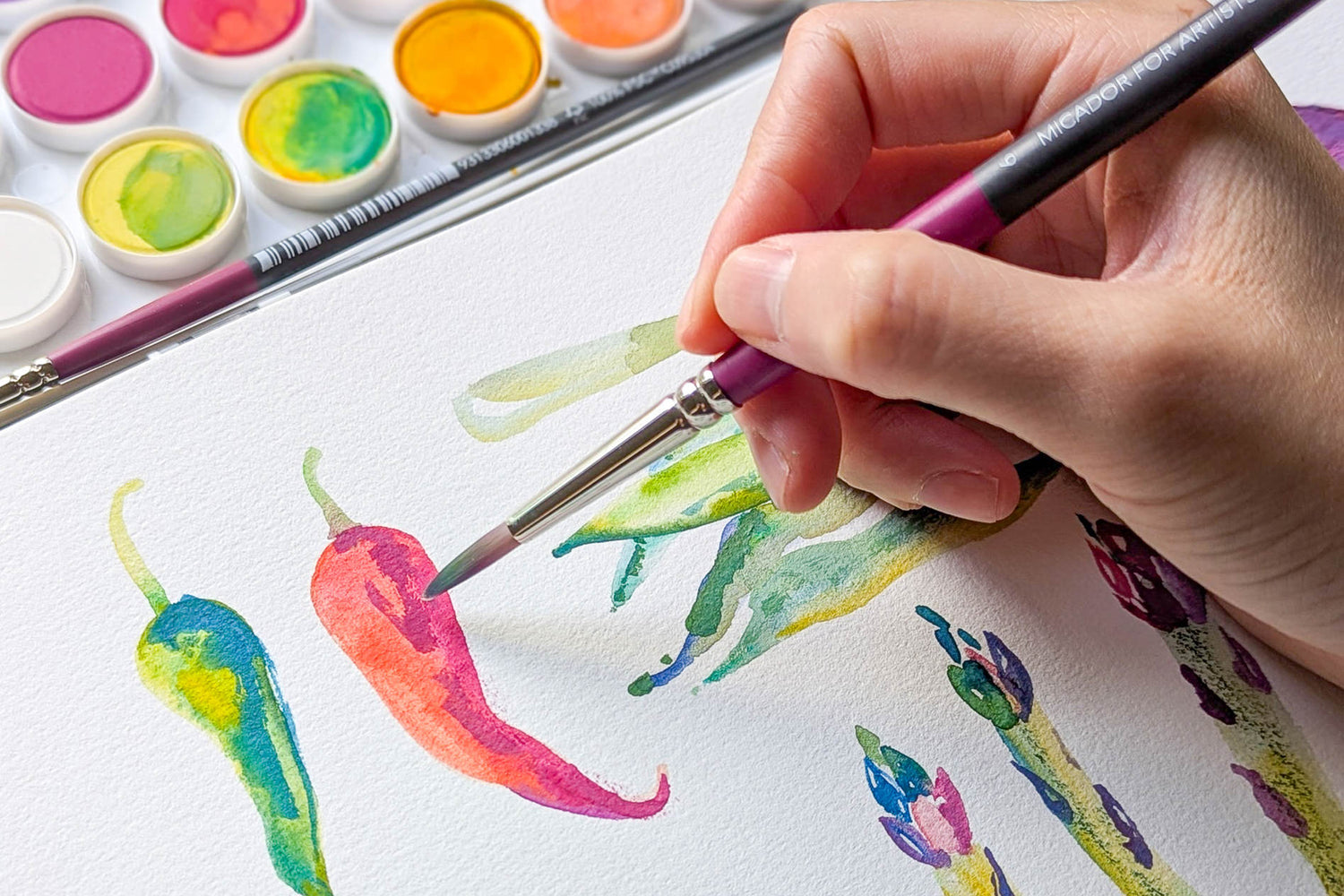
Why Your Brush Matters More Than You Think
Most artists make a critical mistake early on. They focus almost entirely on paint quality, invest in premium pigments, then attach those expensive colours to a brush that can't deliver them properly. The brush is your only connection to the paper. A poor brush makes beautiful paint behave badly. A quality brush makes student-grade paint perform better than you'd expect.
If you understand how brush anatomy works, why different filaments behave the way they do, and which shapes solve specific problems, you'll spend less money overall and achieve better results faster. This guide walks you through the complete decision-making framework Marc Mamet and the Micador team use when recommending brushes to serious watercolour artists.
The Three Filament Categories: Performance and Budget Trade-offs
Watercolour brush filaments fall into three distinct categories. Each has legitimate applications, different working properties, and dramatically different price points.
Natural Hair Filaments
Natural hair brushes use bristles sourced from animal fibres. Kolinsky sable remains the gold standard. These are hairs from the Siberian kolinsky mink, prized for three specific properties that synthetic filaments only recently began matching.
Water holding capacity is exceptional. The natural taper of sable creates a fine point while maintaining an enormous belly that holds water like a reservoir. This matters enormously in watercolour where you're working with water as much as with paint. You can load a sable brush once and make sweeping washes without constant reloading.
Spring and snap refer to the brush's recovery. After you press it into paper, the brush bounces back to its original shape. This responsiveness feels alive in your hand and gives you intuitive control over mark-making. Natural hair does this beautifully. The bristles have a natural curve that helps them return to position.
The natural taper means sable comes to a fine point naturally without being cut or shaped artificially. The hair is thickest at the ferrule and gradually thins. This geometry affects how paint flows from the brush, giving you sharper lines when you work small and broader coverage when you load heavily.
The trade-off is significant cost. A medium-sized natural sable brush for watercolour typically costs $80–$150 depending on the maker. For student budgets, this is prohibitive. Other natural options include squirrel hair (softer, less spring, good for mops) and goat hair (rougher bristles, good for textural work), but kolinsky sable remains the reference point for quality.
Synthetic Filaments (Modern Japanese Technology)
Synthetic brushes have historically been the compromise option, but that assessment is outdated. The jump in synthetic filament technology over the past fifteen years is substantial. Modern Japanese filament engineering, particularly the Revolution and newer ROKU technology used in Micador for Artists' Revolution and ROKU brushes, performs at a level that makes cost-benefit analysis genuinely difficult.
ROKU filaments are engineered to mimic the taper and water-holding properties of natural hair while maintaining consistency. A ROKU watercolour brush uses these filaments rated for 15,000+ strokes of continuous use. That's more than enough for professional practice at any skill level. A medium Revolution watercolour brush costs $15–$25. The price-to-durability ratio is compelling.
The performance differences matter less than most artists assume. ROKU brushes hold water well, come to a point, and deliver paint reliably. The spring isn't quite as pronounced as sable, and the taper isn't quite as fine, but the differences are subtle enough that you'd need side-by-side comparison to notice them in actual painting.
The advantage to synthetic beyond cost is consistency and responsibility. You're not reliant on animal populations or international trade politics. The brush will perform the same way every time you buy one. For teaching environments or large studios, this reliability is genuinely valuable.
Micador's Achiever range offers entry-level synthetic brushes at student prices ($3–$8) with acceptable performance for learners and casual painters. The bristles are less refined than Revolution, the water-holding isn't as generous, but they'll get someone from zero to understanding what a brush does without breaking a budget.
Blended Filaments
Many professional brushes mix natural hair with synthetic. A typical blend might be 70% kolinsky and 30% synthetic. The theory is sound: you get most of natural hair's properties at 60–70% of the cost. The practical result varies. Some blends are genuinely excellent. Others feel like a compromise that doesn't quite commit to either advantage. Buy a blend only when you've tested it or have a specific recommendation from someone whose work you respect.
Brush Anatomy: Understanding What You're Holding
A watercolour brush has three functional parts, each affecting how the brush performs.
The filament is the hair itself. This is where all the distinctions between natural, synthetic, and blended happen. Different filaments hold water differently, taper differently, and spring back differently.
The belly is the thick part of the brush where filaments bunch together. This is where water lives. A generous belly means you can load more water and paint before needing to reload. In watercolour especially, belly size is critical. A small belly forces constant reloading, interrupting your flow. A large belly lets you work washes longer.
The ferrule is the metal crimp holding filaments together. Good ferrules are seamless, with no gaps where bristles can escape. The ferrule determines maximum belly width. A wide ferrule means a bigger belly. When you're looking at a brush, the ferrule diameter tells you a lot about how much water it can hold.
Spring and taper describe how the brush reacts to pressure. When you press the brush against paper, the filaments splay and bend. Spring is how quickly they return to their original shape when you lift. Taper is the brush's natural point formation. In watercolour, moderate spring is ideal. Too much and the brush feels stiff and resistant. Too little and it feels droopy. Natural sable has excellent spring. Good synthetics approximate it closely. Blends vary.
Marc Mamet's key insight: watch how a brush behaves in water before you buy it. A shop that lets you test brushes in clean water will show you spring instantly. Press gently. Lift. Does it snap back sharply? That's good spring. Does it stay bent? Spring is weak.

Brush Shapes: Form Determines Function
Watercolour painters typically work with six primary shapes. Each solves a specific problem or enables a particular technique. Understanding what each shape does helps you avoid collecting brushes you don't actually use.
Round
The workhorse of watercolour. A round brush has a full belly and comes to a fine point naturally. You can load it heavily and make broad washes because of the belly size, then work details with the point without changing brushes. Rounds are the first shape artists should own.
The versatility comes from how you hold and use the brush. Loaded heavily and used flat-sided against paper, a round holds like a small mop. Used tip-first with less water, it draws like a pencil. Most of your early watercolour work will be rounds. They're genuinely that useful. A starter collection might include sizes 6, 10, and 14.
Flat
A flat brush has been manufactured to have a flat, rectangular head. The width gives you defined edges for geometric work. Flats excel at applying uniform colour to areas, creating straight-edged washes, and painting architecture or anything with clean boundaries.
The trade-off is versatility. A flat is efficient for its intended purpose but offers less natural point formation than a round. You can't create a fine line easily. Flats are specialists. If your work involves a lot of clean edges or geometric shapes, they're essential. If you paint expressively or with loose, organic forms, you might never use one.
Mop
A mop brush is a large, fluffy brush with a generous belly and soft filaments. It holds an enormous volume of water, which is why watercolour artists love them. A mop loaded with diluted pigment can lay down a soft wash covering a quarter of your paper before needing to reload.
Mops are texture tools. The softness means edges diffuse and blend easily. For skies, water, and atmospheric effects, mops are unmatched. The downside is lack of control. The softness means you can't create sharp lines. A mop is not a detail brush. But for washes and soft effects, nothing beats it.
Rigger
Also called a liner or script brush, a rigger has extremely long filaments with a fine point. The length means the brush holds an enormous volume of pigment relative to its width. You can draw long, continuous lines without reloading. Riggers excel at branches, grasses, calligraphy-style marks, and fine detail work.
The long hair makes riggers potentially fragile if you press hard. They're control tools, not force tools. Use a rigger with a light touch and let the water and paint flow. Press too hard and you risk breaking bristles.
Dagger (or Sword)
A dagger or sword brush has a flat, pointed shape, like a blade. It's a versatile hybrid that acts like a flat for broad strokes but has a pointed tip for fine work. One dagger can substitute for both a flat and a round in many situations.
If you're working minimally and want to travel with few brushes, a dagger is the compromise shape. It won't perform quite as well as dedicated flats or rounds for their specific purposes, but it's legitimately useful and more versatile than either alone.
Fan
A fan brush has bristles spread in a semi-circle, like a fan. Fans create texture through their geometry. Dry-brush technique is particularly effective with fans. They're specialised tools for specific effects, particularly foliage and grass. Most artists don't need a fan unless they paint landscapes regularly.
How to Choose: Matching Brush to Technique and Budget
The decision framework is straightforward once you accept that there's no single perfect brush, only the right brush for your specific needs.
Start with technique. What will you paint most? If you're learning watercolour broadly, you need versatile shapes. A round and a mop will solve 80% of watercolour problems. If you work in illustration and need fine detail work, you'll need riggers. If you paint architecture, flats matter more.
Then consider budget. If you have $200 to spend on brushes, the mathematics are clear: buy several good synthetics or blends instead of one expensive sable. If you have $2,000, you might have several dedicated sables plus supporting synthetic brushes. Your total budget should guide brush tier, not determine specific brushes.
Buy by function, not quantity. Many artists accumulate brushes without actually using them. Instead, commit to specific shapes you understand. A starter set might be:
- One round (size 10) in medium quality synthetic, for general work
- One mop (size 12) in soft synthetic, for washes
- One rigger (size 2) in synthetic, for detail and lines
This three-brush foundation costs around $30–$40 total and will deliver absolutely everything a learning artist needs. As your technique develops, you'll know exactly which brush behaved badly or felt insufficient. That's when you upgrade or add specialisation.
The upgrade hierarchy: Many artists follow this progression sensibly. Start with Achiever or 907 synthetics at student prices. As you commit to watercolour, move to Revolution brushes where you use them most (usually your primary round and mop). Once technique is strong and you're painting regularly, consider one quality natural hair brush in your most-used size. A single sable round at $100 paired with synthetic flats and riggers is a genuinely professional setup that costs far less than multiple sables.
ROKU Brush Technology: ROKU Filaments at Scale
Micador's ROKU watercolour brushes demonstrate what's possible when you engineer synthetic filaments specifically for watercolour technique. ROKU filaments use a core-and-shell structure that mimics natural taper while maintaining uniform diameter. The result is consistent water-holding and paint delivery across the filament.
The brushes are manufactured through a collaboration between Micador and a business in Japan with decades of filament expertise. Each brush is hand-assembled and tested. The 15,000+ stroke rating comes from actual wear testing, not marketing estimation.
For serious artists on realistic budgets, ROKU represents a shift in the value calculation. You're not buying a compromise to natural hair. You're buying a genuinely different tool engineered for specific advantages. The lower cost isn't because the brush is worse. It's because synthetic fibres can be produced consistently and at scale in ways animal hair cannot.
Testing and Evaluation: How to Know If a Brush Works
Before committing to a brush purchase, test it in water. You need two clear signals.
The spring test: Wet the brush, load a small amount of paint or pigment, press the filaments against paper with moderate pressure, then lift. Does the brush snap back to its original shape instantly? That's good spring. Does it stay pressed or spring back slowly? Spring is weak.
The point test: Look at the brush tip. Does it come to a fine, clean point? Can you draw a line less than 1mm wide with it? If yes, the brush has good taper and point formation. This is especially important for riggers and small rounds.
The belly test: Load the brush fully with water (no pigment necessary). How long can you work on paper before the water depletes significantly? A generous belly means extended working time. Limited belly means constant reloading. Observe which category the brush falls into.
These three tests take thirty seconds and tell you whether the brush will behave well in actual painting.
Brush Care and Longevity: Getting Years From Your Brushes
Your brushes will outlast your paper if you follow three simple protocols.
Never leave brushes standing in water. This is the single most common damage pattern. Standing in water causes filaments to splay permanently and ferrule corrosion to develop. Always rinse brushes immediately after use and store them horizontally or bristles-up in a jar.
Reshape bristles while wet. After cleaning, use your fingers to gently reshape the bristles to their original form. While they dry, they'll hold that shape. This prevents permanent splaying that degrades point formation.
Clean thoroughly. Watercolour pigment dries quickly in ferrules if left uncleaned. Use cool water, never hot (heat damages natural fibres). Rub the brush gently against your palm or use a brush cleaner cake. Don't use bar soap, which leaves residue. The goal is complete pigment removal, not stripping the brush.
Marc Mamet's observation from two decades of teaching: the difference between a brush lasting two years and lasting twenty years is consistent rinsing immediately after use. That's it. Lazy cleaning accounts for 90% of premature brush failure.
A quality brush properly maintained will perform well indefinitely. You're not replacing brushes because they wear out. You're adding brushes because your technique develops and you need different tools.
When to Invest in Natural Hair, and When Not To
The sable decision stops being mysterious once you frame it correctly.
Don't buy sable if: you're still developing fundamental technique, you paint fewer than four times monthly, or you're learning multiple media simultaneously. Your technique will change faster than you can establish a sable's behaviour. Spend that money on synthetic brushes and paper instead.
Buy sable when: you paint regularly (4+ times weekly), your technique is established and consistent, and you've spent enough time with the specific shape and size to know exactly what you need. You're not experimenting anymore. You're building your permanent kit.
For professional watercolour artists, one or two quality natural hair brushes in your most-used sizes will outlast you and perform in ways synthetics approximate but don't fully replicate. But they're luxury additions to a solid synthetic foundation, not replacement purchases.
Summary: Building Your Actual Brush Kit
This guide has given you the decision framework. Your actual kit will reflect your specific needs. But the principles stay constant:
Match brush shape to technique. Choose filament type based on budget and commitment level. Test before buying. Maintain through consistent rinsing. Upgrade thoughtfully into natural hair only when technique is established.
The difference between artists with frustratingly limited brush collections and those with genuinely useful ones isn't how much they spent. It's that the second group thinks about what problems each brush solves instead of collecting by size.
Your brush kit should reflect your actual practice, not aspirational painting you imagine doing. Be honest about what you paint. Invest in brushes that solve those problems. Ignore shapes and sizes you don't use.
Quality watercolour work is achievable with a $40 synthetic kit and good paper. Investing in natural hair when you're ready to will make the work easier and potentially produce better results. But the ceiling on quality isn't set by your brush budget. It's set by your technique, your understanding of watercolour mechanics, and the time you invest in practice.
Your brushes are tools. Use them in service of the work you're actually making.
Ask Klumpf about watercolour brushes, filament types, or which brush suits which wash. Micador's in-house art expert. Bottom-right of every page.
Next in this series: "How Art Materials Actually Work: The Science Behind What You Create With"
© 2026 Micador Group. All rights reserved. This article is original editorial content produced by Micador. You're welcome to link to it or quote short passages with attribution. Reproducing the article in full, or republishing it on another platform, requires written permission — amazing@micador.com.au.

Leave a comment
All comments are moderated before being published.
This site is protected by hCaptcha and the hCaptcha Privacy Policy and Terms of Service apply.