
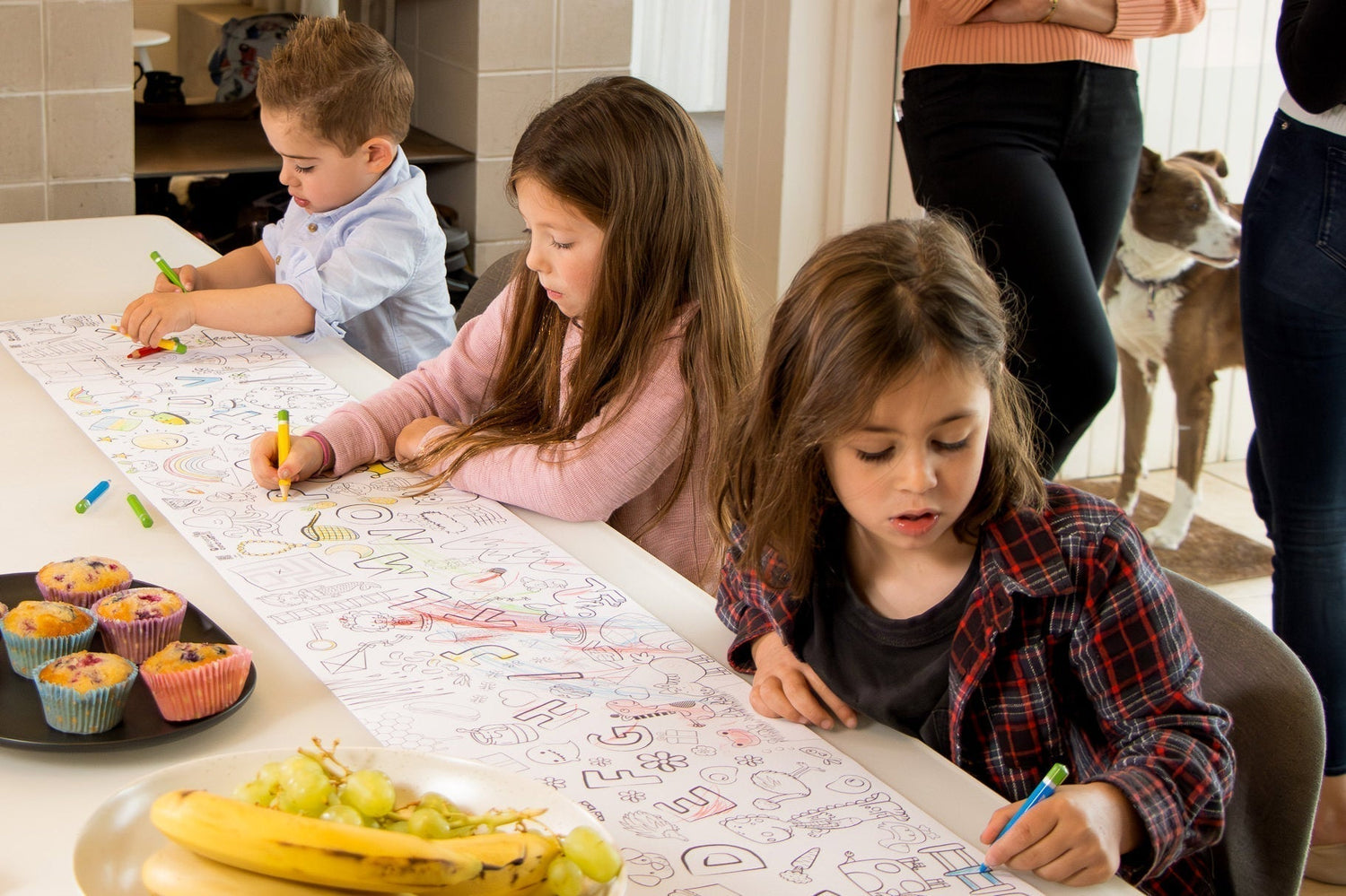
Your three-year-old draws a circle, adds two lines coming out the bottom, and announces: "That's Daddy."
It looks nothing like Daddy. But something extraordinary just happened. Your child connected a mark on paper to a person in their life. A symbol was born. And from here, the next five years of their art development will unfold in a sequence that's remarkably predictable, deeply researched, and far more sophisticated than most adults realise.
The Circle That Changes Everything
Somewhere between two and four, children make the leap from scribbling (which is pure motor exploration, covered in our previous post) to drawing with intention. Developmental researcher Viktor Lowenfeld called this the pre-schematic stage, and it starts with something deceptively simple: a circle with lines attached.
These are "tadpole people." A circle for the head, two lines for legs, sometimes two more for arms. No torso. No fingers. No neck. And here's the thing: this isn't a mistake. Tadpole people appear across every culture researchers have studied. They represent what matters most to a child at this age, the face (where connection happens) and the limbs (where action happens). The torso? Not important yet. It'll arrive around age five, when your child's mental model of a person becomes more detailed.
At this stage, your child's drawings tell you what they think about, not what they see. A person might be bigger than a house because the person matters more. The sky might be green because green is their favourite colour today. Colour use at this age is driven almost entirely by preference and pleasure. Research from Lowenfeld, Kellogg, and others consistently shows no reliable correlation between a young child's colour choices and their emotional state. A child who loves purple will paint everything purple, whether they're drawing a birthday party or a rainstorm.
So when your three-year-old produces a picture with an orange sky and a blue dog, it's not confusion and it's not a sign of something. It's creative exploration, exactly where development should be.
What Their Hands Can Actually Do
Understanding what your child draws starts with understanding what their hand can physically manage. The art follows the motor development, not the other way around.
At three, most children hold a crayon in a full-hand grip, similar to how you'd hold a torch. The whole arm moves. Lines are broad and imprecise. Scissors are tricky: they can open and close the blades but can't steer them in any particular direction. Chunky crayons, thick brushes, and dot markers are the right tools here. Anything requiring finger precision is going to frustrate them, not because they're not interested in art, but because the tool doesn't match the grip.
Between three and a half and four, the grip transitions. The thumb separates from the fingers. Three fingers start working together to hold the tool, though the movement is still coming mostly from the wrist rather than the fingertips. Medium-width crayons and pencils work well now. Scissors can cut short, roughly straight lines with some adult help.
By four to five, most children have developed a dynamic tripod grip, thumb opposite middle finger, with movement coming from the fingers themselves. This is the grip that will carry them through to adulthood. They can now draw shapes with real intentionality, manage a brush with reasonable control, and cut along a line with confidence. Fine-tipped markers and regular pencils become appropriate.
One important note: if a tool is too advanced for your child's grip stage, they compensate by squeezing harder. If this becomes habitual, it can create muscle tension that interferes with fine motor skills down the track. Match the tool to the stage. Let them lead.
Process Over Product: The Single Most Important Thing
Here's where a lot of well-meaning adults get it wrong, and it's worth getting right because the research is very clear on this.
Between three and five, the vast majority of your child's art should be process-focused, not product-focused. Process art means open-ended exploration with no predetermined outcome. Product art means following instructions to create something that looks like a model.
The difference matters because of what's happening cognitively. When a child is exploring freely ("What happens if I mix these two colours?"), they're building intrinsic motivation, problem-solving skills, and creative confidence. When they're following a template ("Glue the cotton balls on the sheep"), they're solving a different problem entirely: "How do I make mine look like the one on the board?"
The Reggio Emilia approach, one of the most studied early childhood frameworks in the world, describes children as having "a hundred languages" for expressing ideas. Art is one of those languages. Process art lets them speak in their own voice. Templates ask them to read from a script.
This doesn't mean craft kits and structured activities are forbidden. Kids enjoy them, and there's a place for them. But the bulk of art time at this age should be open-ended: paint, clay, collage materials, markers, and time. No model to copy. No "correct" result. The mess is the learning.
Practically, that means providing a few colours of paint (start with just the primaries), some brushes and paper, and stepping back. Resist the urge to suggest what to draw. If they ask, try: "What do you feel like making?" rather than "Why don't you draw our house?"
Twenty to thirty minutes is enough. The quality of the exploration matters far more than the duration.

Ages 6-8: When Drawings Develop Rules
Something shifts around six. Your child's drawings become consistent. The same house appears in every picture: triangle roof, square body, four windows, door in the middle. The same person appears: circle head, rectangle body, stick limbs. The same tree: circular green top on a straight brown trunk.
Lowenfeld called this the schematic stage, and the key word is schema, a repeatable visual solution that a child stores mentally and deploys reliably. They've worked out how to draw a house. Now they draw that house in every scene, whether it's a beach, a farm, or their street.
This looks like they've stopped improving. They haven't. Schema repetition is consolidation. Your child has solved a complex representational problem ("How do I make a mark that communicates 'house'?") and is now reinforcing it. This is the same process that happens when a child learns a new word and uses it constantly for a week. They're locking it in.
Two other things appear at this stage that are worth understanding.
First, the baseline. Objects stop floating randomly on the page. A brown line appears at the bottom (ground) and often a blue line at the top (sky). This is spatial organisation, your child working out that things exist in physical relationship to each other.
Second, X-ray drawings. Your child draws a house, then draws the family inside it, visible through the walls. Or draws a person in profile but includes both eyes. This is called intellectual realism: drawing what they know is there, rather than what they'd see from a single viewpoint. It's not a mistake. It's actually sophisticated thinking. They're prioritising completeness of information over visual accuracy from a single perspective. It resolves naturally, usually by eight or nine, when they start to notice the contradiction.
The Moment It Gets Hard
Somewhere between seven and nine, something happens that catches a lot of parents off guard. Your child looks at their drawing and says: "That doesn't look right."
This is the beginning of the shift from intellectual realism to visual realism, from drawing what they know to drawing what they see. It's a genuine cognitive leap. And it comes with a frustration zone, because the child can now see the gap between their drawing and reality, but doesn't yet have the skills to close it.
This is the moment many children decide "I can't draw." Not because they've lost ability, but because their perception has outpaced their technique. They're noticing proportion, overlap, perspective, and viewpoint consistency for the first time, and their schematic drawings can't keep up.
If your child hits this stage, three things help. First, provide something real to look at. Drawing from observation (a piece of fruit, a shoe, their own hand) is fundamentally different from drawing from memory, and it's the bridge to visual accuracy. Second, teach one specific skill at a time: "Try making the far tree smaller than the near one" or "Look at where the handle meets the cup." Third, name what they're doing: "I can see you're looking really carefully at the shape. That's exactly what artists do."
What doesn't help: telling them it looks great when they can see it doesn't. They need skills, not reassurance.
New Materials for Growing Hands
By six to eight, your child's hands are ready for more complex materials. Here's what works and when.
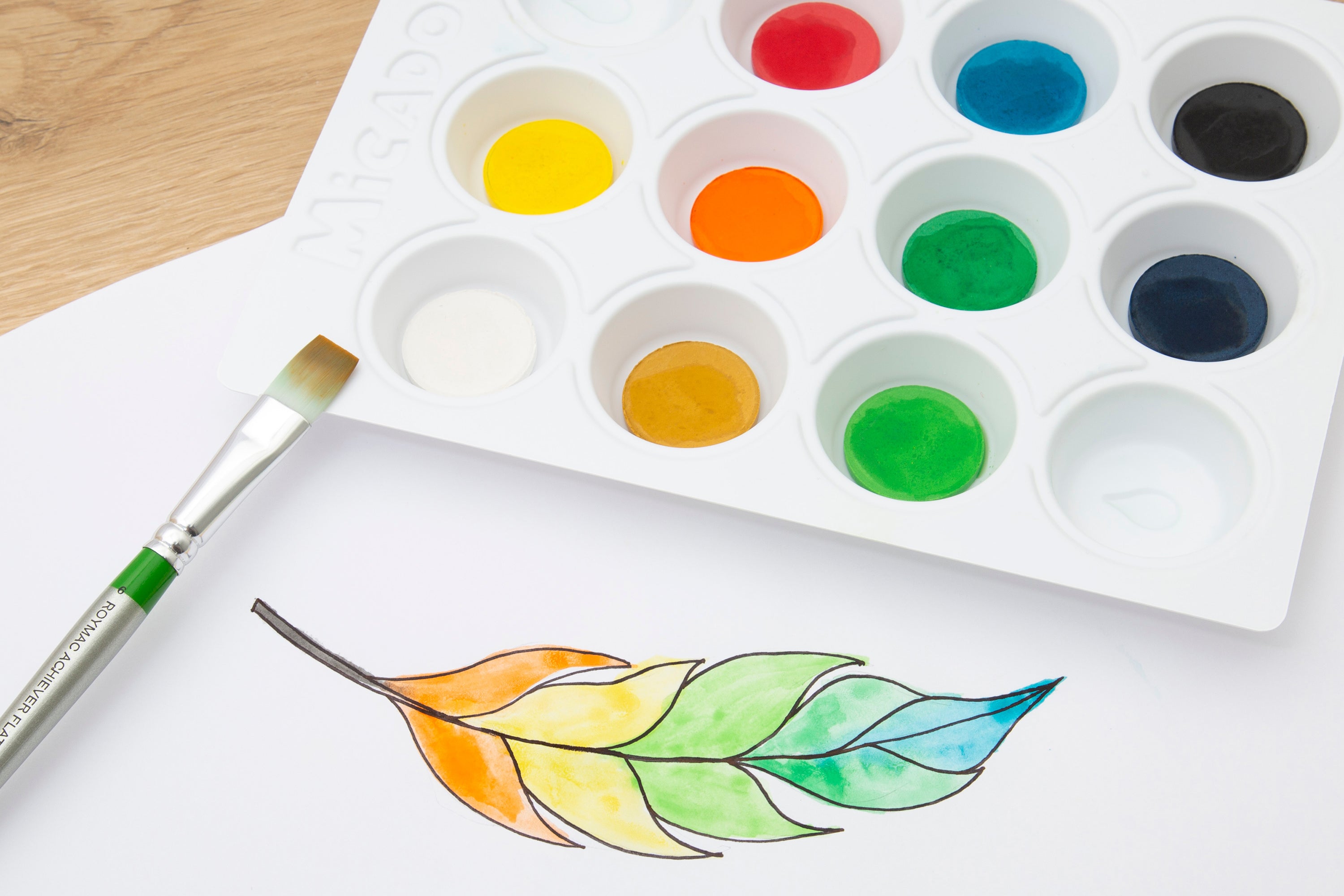
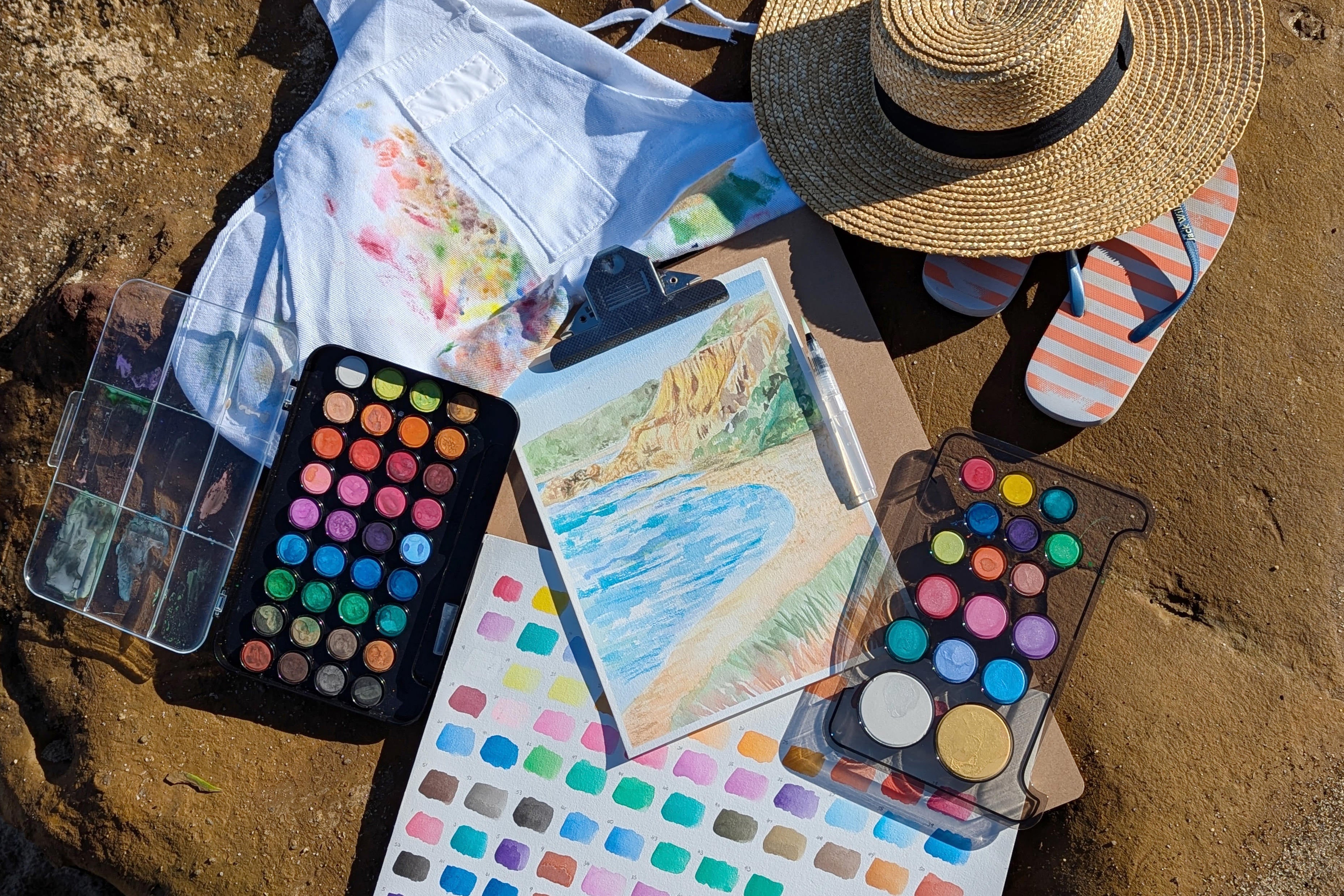
Watercolour paint is a genuinely complex medium. It requires brush control, water management, colour mixing, and an understanding of transparency that's quite different from markers or crayons. Most children are ready by Grade 2 or early Grade 3. Start with three colours only (red, yellow, blue), demonstrate the sequence explicitly (wet brush, load paint, mix on palette, apply, rinse), and let them have five minutes of free experimentation on scrap paper before starting. Muddy colours aren't failure. They're what happens when you're learning how water and pigment interact.
Clay is wonderful at this age because it's reversible. You can squash it and start again, which makes it psychologically safe for experimentation. Air-dry clay is the best option for home and most classrooms (no kiln needed, quick results, low mess). At six to seven, expect large, simple forms: balls, snakes, lumps with poked-in faces. By seven to eight, you'll see deliberate construction, joining pieces together, making things that stand up, and early attention to proportion.
Printmaking is surprisingly accessible. Stamp printing with found objects (leaves, bottle caps, textured surfaces) dipped in washable ink produces satisfying results with relatively low fine motor demand. It also introduces the idea of positive and negative space in a playful way.
Collage is the great equaliser. It requires minimal fine motor skill but builds composition thinking, colour decision-making, and conceptual planning. Pre-tear or pre-cut a variety of papers, let your child arrange pieces on a base sheet before gluing, and watch them make design decisions that are genuinely sophisticated.
The key with all new materials: introduce one per month. Let your child build familiarity before adding the next thing. And always check readiness individually, not every six-year-old is ready for the same material at the same time.
How to Talk About Their Art
The way adults respond to children's art has measurable effects on their creative development. Research is clear on what works.
What doesn't work: generic praise ("That's beautiful!"), comparative praise ("That's the best one!"), or evaluative judgments ("I love it!"). These teach children to seek approval rather than explore.
What does work: descriptive feedback. Describe what you actually see.
"I can see you used lots of different greens in the trees. How did you mix those?"
"You've drawn the dog much bigger than the house. Tell me about that."
"I notice you used small marks here and big marks there. What made you change?"
This kind of feedback tells your child you're paying real attention to their work, and it keeps the ownership with them. Follow it with: "What would you change if you made another one?" That question alone builds more artistic thinking than a hundred "good jobs."
The Big Picture
Between three and eight, your child goes from random circles to houses with people inside them, from a full-fist grip to precise finger control, from pure motor exploration to intentional symbolic communication.
Every stage has its own logic. Tadpole people aren't wrong, they're efficient. Repeated houses aren't boring, they're consolidation. X-ray drawings aren't confused, they're comprehensive. Green skies aren't mistakes, they're preferences.
The best thing you can do at every stage is the same: provide appropriate materials, give them time and space, resist the urge to direct, describe what you see, and trust the process. The art is doing exactly what it needs to do.
Ask Klumpf about your kid's drawings, grip stages, or what to do when they ask "is this good?"
Micador's in-house art expert. Bottom-right of every page.
Next in this series: "Why Kids Stop Drawing at 10 (And How to Keep Them Creating)"
© 2026 Micador Group. All rights reserved. This article is original editorial content produced by Micador. You're welcome to link to it or quote short passages with attribution. Reproducing the article in full, or republishing it on another platform, requires written permission — amazing@micador.com.au.

Leave a comment
All comments are moderated before being published.
This site is protected by hCaptcha and the hCaptcha Privacy Policy and Terms of Service apply.